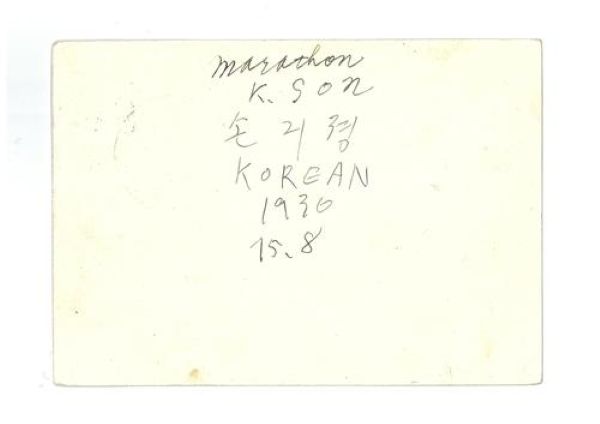
This image, provided by the National Museum of Korea on July 24, 2025, shows a postcard signed by the late Korean Olympic marathon champion Sohn Kee-chung. (Yonhap)
SEOUL, July 24 (Korea Bizwire) — The National Museum of Korea announced Thursday it will launch a new exhibition this week on a Korean-born marathoner’s record-breaking Olympic victory during the 1910-45 Japanese colonial period.
Set to open Friday under the title “The Radiant Strides, Moving the World,” the exhibition will celebrate the achievements of the late runner Sohn Kee-chung, who won the men’s marathon gold medal at the 1936 Berlin Olympics while wearing the Japanese flag. He set an Olympic record with 2:29:19.
Though Sohn was the first Korean-born athlete to win an Olympic gold, he went into the record books as a Japanese medalist in Berlin. During the medal ceremony, Sohn famously held an oak sapling in front of him to hide the Japanese flag on his chest, while Korean newspapers altered the image to remove the Japanese flag from Sohn’s running tunic.
The exhibition features Sohn’s handwritten postcard, on which he signed “Korean” in English, along with his name written in Korean. It is dated Aug. 15, 1936, six days after his gold medal race.
According to the museum, Sohn signed his name in Korean at every opportunity he had during the colonial period so that people would know he was not Japanese.
The postcard is “an important material that demonstrates his strong determination to show his identity as a Korean,” the museum explained.
Other items include Sohn’s gold medal, the Corinthian helmet belatedly presented to Sohn as a prize, laurel wreath and newspaper clippings detailing Sohn’s victory.
The helmet, from the sixth century B.C., was discovered in Greece and was supposed to have been awarded to Sohn as the marathon champion. However, the International Olympic Committee decided handing out such a valuable gift would violate the amateur spirit of the Olympic Games.
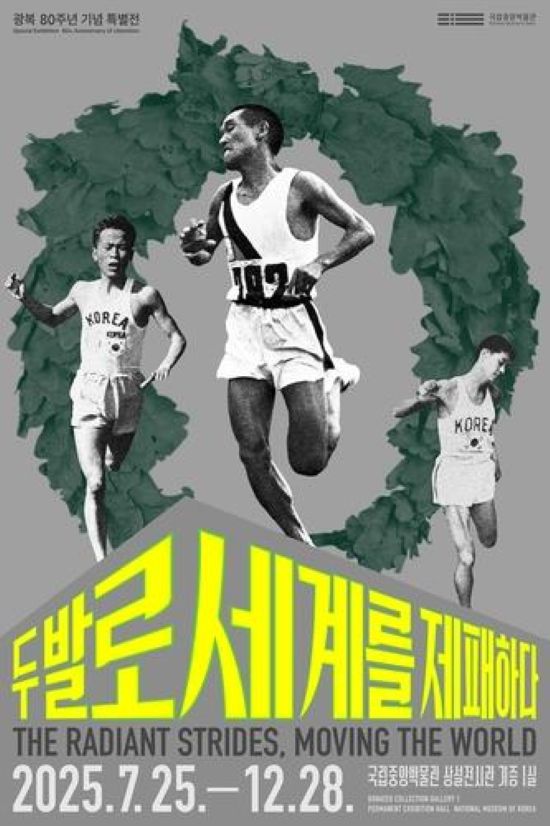
This poster, provided by the National Museum of Korea, promotes the new exhibition, “The Radiant Strides, Moving the World,” highlighting the achievements of the late Korean Olympic marathon champion Sohn Kee-chung. (Yonhap)
The helmet was held in a German museum before Sohn finally received it in 1986, during the 50th anniversary celebration of the Berlin Games. It was designated as South Korea’s National Treasure in 1987, and Sohn donated it to the National Museum in 1994.
The museum leaned on artificial intelligence to recreate Sohn’s gold medal-winning run in 1936 and also his torch relay during the 1988 Seoul Olympics.
Held in commemoration of the 80th anniversary of Korea’s liberation from Japan, the exhibition will run through Dec. 28.
(Yonhap)