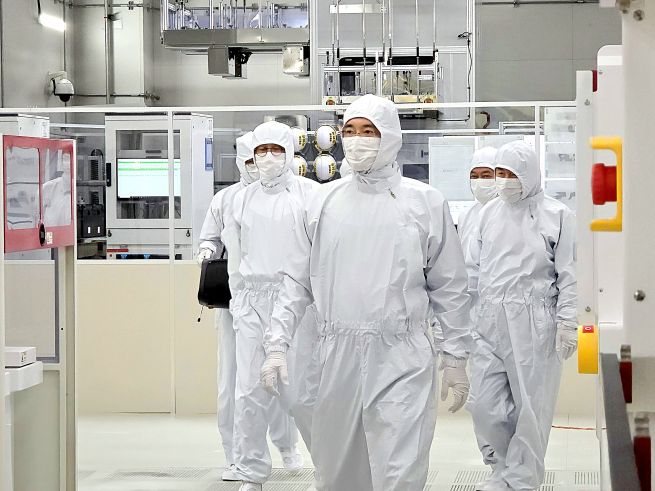
Samsung Electronics Chairman Lee Jae-yong (front) examines the semiconductor research and development complex of the company, located in Giheung, south of Seoul, in this photo provided by the company on Dec. 22, 2025. (Yonhap)
SEOUL, Jan. 8 (Korea Bizwire) — Samsung Electronics posted a sharp rebound in earnings in the fourth quarter of 2025, buoyed by a surge in its semiconductor business, but the results also exposed widening disparities across its non-chip divisions as rising component costs weighed on consumer electronics.
The company said Thursday that preliminary fourth-quarter revenue reached 93 trillion won ($70 billion), with operating profit estimated at 20 trillion won. About 80 percent of that profit—roughly 16 trillion won—was generated by its Device Solutions (DS) division, driven by higher memory prices and expanding shipments of high-bandwidth memory used in artificial intelligence applications.
The results marked a near sevenfold increase in chip profits from a year earlier, reflecting what analysts described as a full-fledged memory “supercycle.” But that same price surge has become a burden for Samsung’s finished-device businesses, which rely heavily on semiconductors as key inputs.
Samsung’s mobile division, which produces its Galaxy smartphones, was hit particularly hard. Analysts estimate that operating profit at the Mobile Experience (MX) unit fell to between 1.8 trillion and 2.2 trillion won, down sharply from the previous quarter, as seasonal weakness combined with rising costs for memory and other components.
The company is expected to unveil its Galaxy S26 lineup in late February, but analysts caution that continued memory price inflation could limit profit growth in the near term.
“Rising memory prices have clearly benefited the semiconductor business, but they are eroding margins in the device segment,” said Seo Seung-yeon, an analyst at DB Securities, noting that the fourth quarter lacked major smartphone launches to offset higher costs.
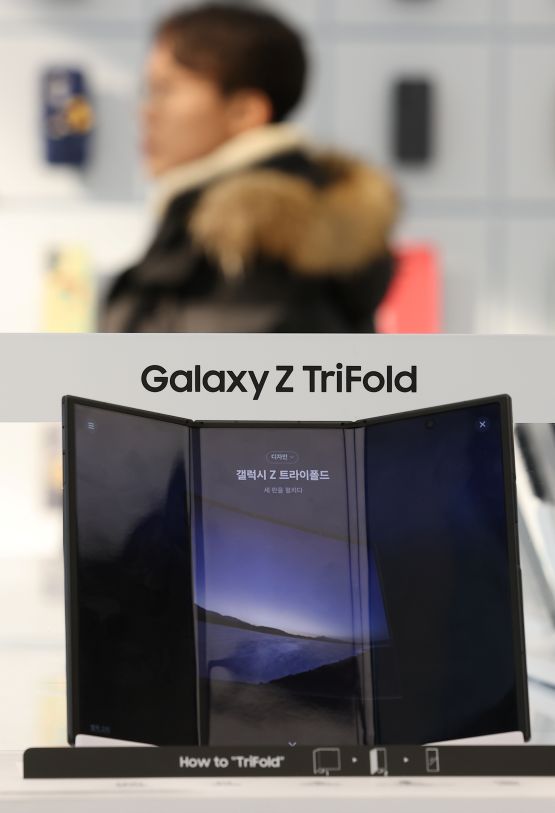
The Galaxy Z TriFold is on display at Samsung Gangnam in Seoul’s Gangnam District. (Image courtesy of Yonhap)
Samsung executives have acknowledged the pressure. Speaking to reporters in Las Vegas this week, Roh Tae-moon, head of the company’s Device Experience division, said rising memory prices were a major concern and would inevitably affect the pricing of Samsung’s products.
Elsewhere, performance was mixed. Samsung Display is expected to have posted operating profit of around 2 trillion won, more than double a year earlier, helped by strong demand for OLED panels used in Apple’s latest iPhone models. Samsung supplies OLED displays for the entire iPhone 17 lineup, including the Pro and Pro Max models.
Harman, Samsung’s automotive and audio subsidiary, is also projected to have delivered more than 400 billion won in quarterly operating profit, putting it on track for record annual earnings above 1.6 trillion won.
By contrast, Samsung’s home appliance and television businesses are estimated to have remained in the red for a second consecutive quarter, as weak demand and cost pressures continued to weigh on profitability.
Market researchers at Counterpoint Research forecast that memory prices, which jumped 40 to 50 percent in the fourth quarter, will rise by a similar margin in the first quarter of 2026, followed by an additional 20 percent increase in the second quarter—raising the likelihood of higher prices for consumer electronics.
The results underscore a familiar dilemma for Samsung: as its chip business thrives on rising prices, its device divisions face mounting cost pressures, complicating the outlook for a company straddling both sides of the semiconductor value chain.
Kevin Lee (kevinlee@koreabizwire.com)