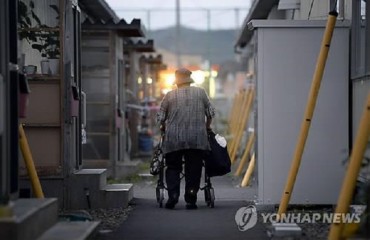
Senior and Youth (CG) .(Image courtesy of Yonhap)
SEOUL, June 17 (Korea Bizwire) — In a striking shift driven by demographic change, South Korea’s workforce participation rate among people aged 60 and older has reached near parity with that of the country’s youth, signaling a new era in the nation’s labor market.
According to data released Monday by Statistics Korea, the economic participation rate for seniors aged 60 and over stood at 49.4% in May—meaning nearly half of this age group was either employed or actively seeking work. This figure is just 0.1 percentage point below the participation rate for those aged 15 to 29, which stood at 49.5%.
It marks the closest the two age groups have been since such data collection began in 1999, with the senior rate also reaching an all-time high. The participation gap is already reversed in more than half of South Korea’s 17 regions, including major cities like Daegu and Gwangju.
The convergence is fueled by a dual phenomenon: rising labor activity among seniors and a prolonged decline among younger Koreans. While older workers remain in or return to the job market—often due to financial necessity—more young people are exiting it altogether. Since May 2024, youth participation has fallen for 13 consecutive months, largely attributed to limited quality jobs in manufacturing and construction and a corporate hiring preference for experienced candidates.
The number of young people categorized as “resting”—not working, not seeking work—reached nearly 396,000 last month. Though down slightly from a year earlier, the cumulative total for 2025 still reflects an upward trend.
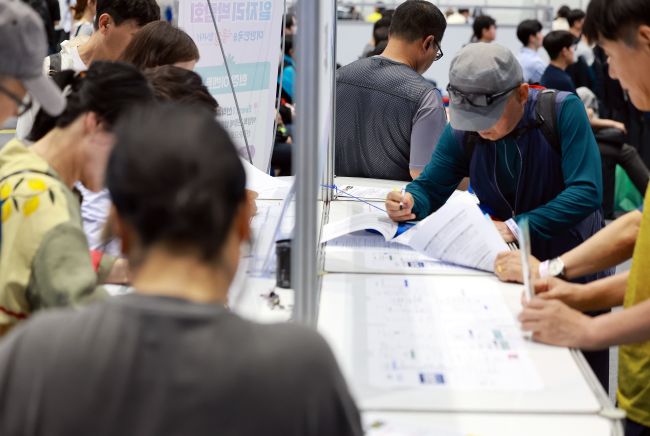
The Era of 7 Million Working Seniors. (Image courtesy of Yonhap)
Experts warn that the rise in elderly workforce participation is not purely a success story. Many seniors continue to work out of economic compulsion, not choice. South Korea’s elderly poverty rate remains the highest among OECD nations at 38.2%, with average monthly pension income for retirees at just ₩800,000—far below the 2024 minimum cost of living for single-person households, set at ₩1.34 million.
Additionally, job security remains elusive for older workers. As of August 2024, more than 2.8 million seniors were employed in non-regular positions, the highest among all age groups.
“The labor market is increasingly being supported by the older generation, while more youth are dropping out or delaying entry,” said Kim Kwang-seok, head of research at the Korea Economic and Industry Institute. “This structural imbalance is likely to deepen in the coming years unless underlying issues are addressed.”
The data underscores a sobering reality: as Korea’s population ages and social safety nets remain insufficient, retirees are becoming a growing and indispensable segment of the nation’s active labor force.
Lina Jang (linajang@koreabizwire.com)