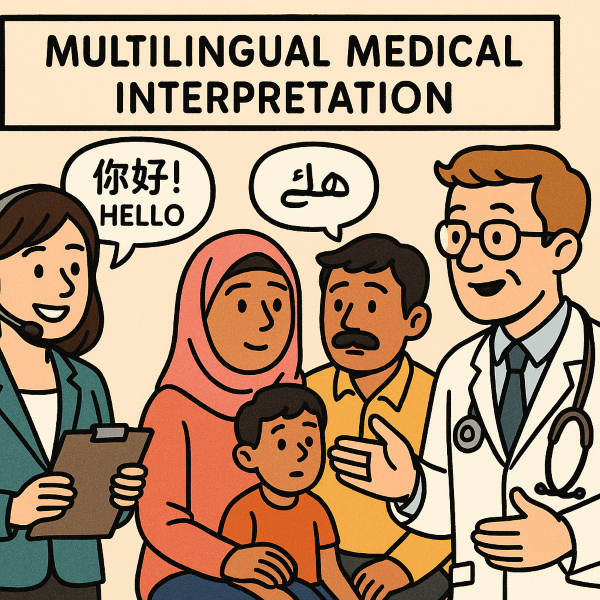
Seoul expands healthcare access for foreigners with new-Interpretation support. (Image created by AI/ ChatGPT)
SEOUL, May 2 (Korea Bizwire) — In a bid to improve access to healthcare for foreign residents and multicultural families facing language barriers, the Seoul Metropolitan Government has launched the “2025 Seoul Medical Interpretation Support Corps” (MeSic), city officials announced Thursday.
The initiative, which began this month, enlists a team of 43 qualified interpreters—comprising trained foreign residents and Korean citizens—who have completed specialized medical interpretation programs. The interpreters will assist in high-stakes medical situations such as treatment of serious illnesses, surgeries, hospitalizations, and advanced diagnostic procedures.
Interpretation services will be available in ten languages: Chinese, Russian, Vietnamese, Mongolian, English, Khmer, Japanese, Thai, Hindi, and Urdu. Eligible users can apply starting May 7 through banners on the Seoul Global Center website or the Hanultari multicultural family portal, as well as via QR codes on promotional materials.
Requests must be submitted at least three business days before the scheduled medical visit. Services will operate on weekdays from 9 a.m. to 6 p.m., with users allowed a maximum of four hours per session and up to four sessions per year. The entire application and matching process will be managed by the NGO Ililshihoil, which operates the Eastern Seoul Center for Foreign Residents.
The city also plans to collaborate with local universities to expand the program’s professionalism through mentoring, quality monitoring, and satisfaction analysis.
According to a 2020 National Human Rights Commission report, 24.5% of migrants who communicated without an interpreter at medical facilities said they struggled to understand the doctor’s explanation. In contrast, over 90% of those assisted by interpreters reported clear understanding.
Further data from Statistics Korea in 2024 revealed that 6% of migrants had avoided medical care despite being ill in the past year, with 38.7% citing language difficulties as the primary reason.
“We hope this program will ensure safer and more convenient medical access for foreign residents and multicultural families who have long struggled with language barriers,” said Lee Hae-seon, Director of Seoul’s Global City Policy Office.
Ashley Song (ashley@koreabizwire.com)