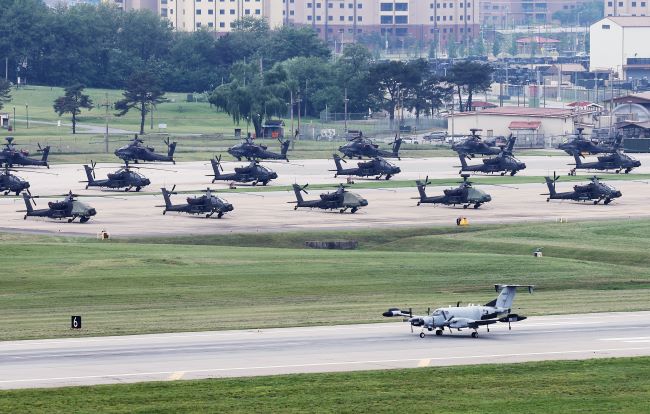
U.S. aircraft are spotted at Camp Humphreys, a U.S. military base some 65 kilometers south of Seoul, on May 23, 2025. (Image courtesy of Yonhap)
SEOUL, May 23 (Korea Bizwire) — South Korea’s defense ministry said Friday it has not held any discussions with the Pentagon over the possibility of scaling back U.S. Forces Korea (USFK) troops stationed in South Korea, stressing it is a matter that requires bilateral consultation.
The remark came in response to a report by The Wall Street Journal that U.S. President Donald Trump’s administration is considering withdrawing some 4,500 troops, or 16 percent, of the 28,500-strong USFK and relocating them to other locations in the Indo-Pacific, including Guam.
Citing defense officials, the report said the idea is being prepared as part of an informal policy review for consideration by the U.S. president on coping with North Korea.
“As the core strength of the South Korea-U.S. alliance, the USFK, alongside our military, has contributed to the peace and stability of the Korean Peninsula and in the region by maintaining a firm combined defense posture and deterring North Korea’s invasion and provocation,” the ministry said.
“We will continue to cooperate with the U.S. side to advance in such a direction,” it said.
A defense ministry official also emphasized that a possible reduction of USFK troops on the Korean Peninsula is a matter that mandates consultation between the allies.
“A change in USFK troops is a matter that requires bilateral consultation, based on the spirit of the South Korea-U.S. alliance and mutual respect,” a ministry official told reporters, adding such a plan would have to go through certain procedures, such as the Security Consultative Meeting (SCM) and the Military Committee Meeting (MCM).
SCM is an annual meeting of the defense chiefs of the two nations, while MCM refers to annual talks between the allies’ military chiefs.
A Pentagon spokesperson told Yonhap News Agency that there are no policy announcements to make regarding any potential USFK troop reduction.
The report comes amid views that Washington may seek “strategic flexibility” of the USFK to broaden its role to better deal with China’s growing assertiveness rather than prioritizing North Korean military threats.
U.S. Defense Secretary Pete Hegseth has ordered the development of the Pentagon’s 2025 National Defense Strategy (NDS) to focus on raising “burden-sharing” with allies and deterring China threats in the Indo-Pacific.
The final draft of the NDS is set to be submitted to Hegseth no later than Aug. 31, amid speculation that the strategic road map may also include raising South Korea’s burden for stationing the USFK on the Korean Peninsula.
In October, Seoul and Washington signed the latest version of the five-year Special Measures Agreement (SMA), effective through 2030, under which Seoul is to pay 1.52 trillion won (US$1.1 billion) next year for the upkeep of the USFK, up 8.3 percent from 2025.
But Trump called South Korea a “money machine,” saying that Seoul would be paying $10 billion a year to station the USFK had he been in the White House when he was a presidential candidate.
Since 2008, the USFK has maintained a troop level of 28,500 on the Korean Peninsula, across components of the Eighth Army, the Seventh Air Force, U.S. Naval Forces Korea, U.S. Marine Corps Forces Korea and the U.S. Special Operations Command Korea.
(Yonhap)