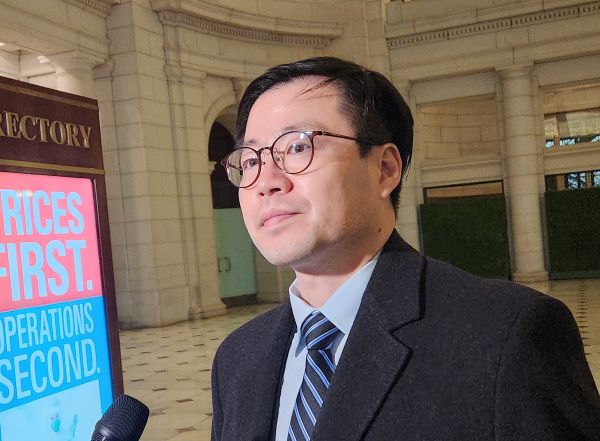
Trade Minister Yeo Han-koo speaks to the press at a train station in Washington on Jan. 14, 2026. (Yonhap)
WASHINGTON•SEOUL, Jan. 15 (Korea Bizwire) – South Korea is preparing for “all possibilities” as it weighs how to respond if the U.S. Supreme Court strikes down President Donald Trump’s sweeping, country-specific tariffs, a senior trade official said Wednesday, underscoring the uncertainty facing global markets as Washington’s trade policy hangs in the balance.
Trade Minister Yeo Han-koo, speaking to reporters in Washington, said Seoul would seek an “optimal” response while closely tracking how other U.S. trading partners react. The comments came as the Supreme Court considers the legality of Mr. Trump’s use of the International Emergency Economic Powers Act, a 1977 law he has invoked to impose so-called reciprocal tariffs on most trading partners, including South Korea, the European Union and Japan.
Mr. Yeo had planned to return to Seoul on Wednesday but delayed his flight to assess the potential fallout from a new presidential proclamation signed the same day, which imposes a 25 percent tariff on certain artificial-intelligence-related semiconductors.
“Depending on how the situation unfolds, we will need to make a careful judgment, while watching how other countries with trade agreements with the United States respond,” Mr. Yeo said, when asked how South Korea would act if the court rules against the tariffs.
During his meetings in Washington, he said, he sensed a strong determination within the Trump administration to maintain its tariff policy even in the face of an adverse court ruling. Legal experts, he added, see the case as too close to call, with a decision possible at any time.
A ruling against the tariffs could trigger a complex process for companies seeking refunds on duties already paid, analysts have warned. Mr. Yeo said the South Korean government is preparing for that scenario as well, but cautioned that a court decision would not necessarily end the administration’s use of tariffs.
Even if the Supreme Court curtails the emergency powers authority, the administration could turn to other statutes to continue imposing duties, Mr. Yeo said, pointing to the Trade Act of 1974, which allows tariffs in response to unfair trade practices, and older provisions that permit duties against countries deemed to discriminate against U.S. commerce.
On the newly announced chip tariffs, Mr. Yeo said it was too early to assess the impact on South Korean semiconductor makers. The proclamation targets certain AI chips imported into the United States and then re-exported, while exempting chips destined for U.S. data centers or for consumer use within the country.
Officials in Seoul, he said, are reviewing the details closely in coordination with industry, as the Trump administration continues to use tariffs as a central tool to raise revenue, bolster domestic manufacturing and attract foreign investment.
M. H. Lee (mhlee@koreabizwire.com)