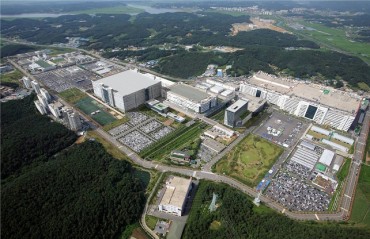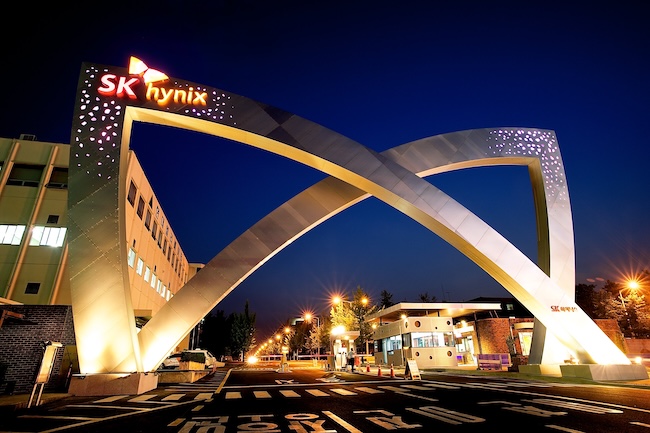
The front gate of SK hynix Inc.’s headquarters in Icheon, about 50 kilometers southeast of Seoul, is seen in this photo provided by the company. (Image courtesy of Yonhap)
SEOUL, Dec. 24 (Korea Bizwire) — SK Hynix on Wednesday urged South Korea’s government to loosen fair-trade regulations, arguing that existing ownership rules are ill-suited to the scale and financial demands of investment in the artificial intelligence era.
The chipmaker said regulatory flexibility is needed to allow it to set up special purpose companies with outside investors to help finance massive, long-term projects. Under current rules, SK Hynix — a second-tier affiliate of SK Group controlled through intermediate holding company SK Square — must retain full ownership when establishing a third-tier subsidiary, limiting its ability to bring in external capital.
The appeal comes after the government earlier this month signaled it would consider lowering the ownership requirement to 50 percent, part of a broader effort to give semiconductor companies more room to raise funds as competition intensifies.
“Amid the intensifying race for cutting-edge technologies in the AI era, both the scale and methods of investment have changed fundamentally,” SK Hynix said in an unusually direct statement posted on its website.
The company added that discussions over regulatory reform should focus not on individual firms, but on how to sustain investment in advanced industries as conditions evolve.
SK Hynix pointed to the sharp rise in capital costs as evidence of the mismatch between regulation and reality. When it announced the Yongin semiconductor cluster project in 2019, the cost of building a 33,000-square-meter clean room was estimated at 7.5 trillion won, or about $5.1 billion.
By the time the company opened its M15X fabrication plant in 2025, the cost of a comparable facility had surged to around 20 trillion won.
This file photo taken Oct. 29, 2025, shows the logo of SK hynix Inc. at its headquarters in Icheon, southeast of Seoul. (Yonhap)
Such super-sized investments, the company said, are increasingly difficult to finance under traditional structures, particularly in an industry marked by cyclical swings and long payback periods.
Allowing second-tier subsidiaries to establish special purpose companies jointly with external investors would significantly reduce financial strain and improve balance-sheet resilience, SK Hynix argued, while enabling sustained investment in next-generation manufacturing.
“In a semiconductor industry characterized by high volatility, this kind of flexibility is critical to maintaining competitiveness,” the company said.
The debate highlights the growing tension between South Korea’s traditional corporate governance framework and the capital-intensive demands of the global chip race, as policymakers weigh how far to adjust rules to support national champions in strategic industries.
Kevin Lee (kevinlee@koreabizwire.com)