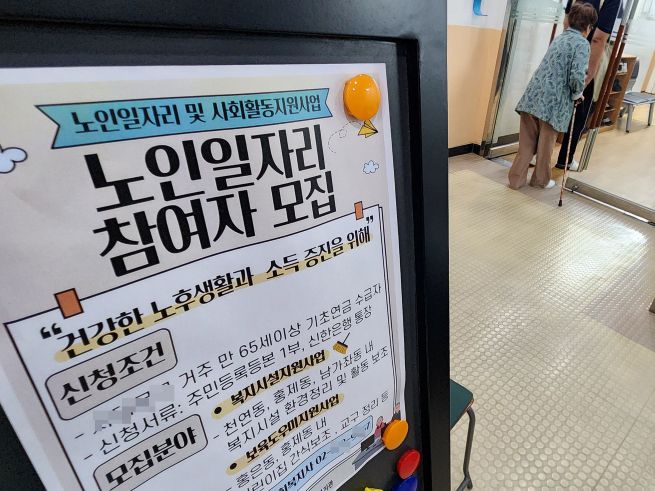
A recruitment poster for senior employment program participants is displayed at the entrance of a local community center. (Yonhap)
SEOUL, May 27 (Korea Bizwire) — South Korea has the highest employment rate among people aged 65 and older across the OECD, but the quality of jobs available to the elderly remains alarmingly low, driven by insufficient pension income and limited opportunities to leverage their lifelong careers.
According to a recent report released by the National Assembly Budget Office, South Korea’s employment rate for those 65 and older stood at 37.3% as of 2023 — nearly three times the OECD average of 13.6%, and significantly higher than Japan’s 25.3%, despite its reputation as a super-aged society.
The report attributes this high employment rate not to policy success but to economic necessity. The average monthly pension income for seniors is only about 800,000 won ($600), well below the national minimum cost of living for a single household, estimated at 1.34 million won in 2024. As a result, many elderly workers reenter the job market to bridge this gap.
Yet the jobs they find are often precarious and physically demanding. Over 61% of elderly wage earners are in non-regular positions, and nearly half work at businesses with fewer than 10 employees. The most common roles for older workers are in low-skill, manual labor — with 35.4% engaged in elementary occupations and 15% in machine operation.
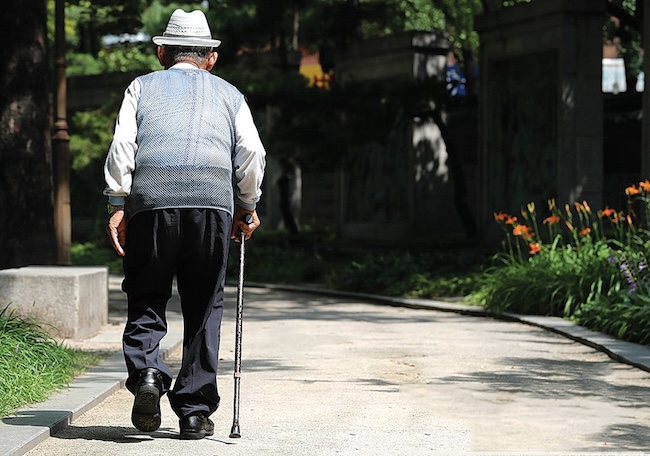
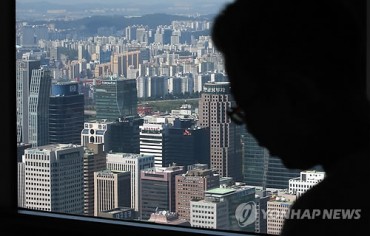
South Korea’s elderly population is grappling with insufficient pension income. (Image courtesy of Yonhap)
This trend is closely tied to what researchers call a “career disconnect.” More than half (53.2%) of those aged 65 and over who rejoined the workforce said their current roles had little or no connection to their previous careers. This mismatch prevents them from utilizing their accumulated expertise and often results in a sharp drop in wages.
For instance, the average monthly wage for workers in their late 50s is around 3.51 million won, while those in their early 60s — typically reemployed retirees — earn just 2.79 million won on average, a 20.5% decline.
The report underscores the need for systemic solutions, calling for better support to help older adults remain in or return to roles aligned with their main career paths. “Korea’s older population has a strong willingness to continue working after retirement,” the report notes. “Helping them stay in relevant roles longer can reduce income gaps in old age and better utilize their human capital.”
To address the growing employment gap and job quality crisis among seniors, the report recommends comprehensive strategies to resolve career discontinuities, improve job matching, and support reemployment in fields that align with older workers’ previous experience.
M. H. Lee (mhlee@koreabizwire.com)