Preparing for the Next Climate Era, Korea Bets on Law and AI (Yonhap)
SEOUL, Dec. 24 (Korea Bizwire) — South Korea’s government plans to enact a sweeping Climate Adaptation Act next year and expand the use of artificial intelligence to forecast floods, road icing and wildfires, as it steps up preparations for intensifying climate risks, officials said Tuesday.
The Ministry of Climate, Energy and Environment said the Fourth National Climate Crisis Adaptation Plan for 2026–2030 was approved by the presidentially affiliated 2050 Carbon Neutrality and Green Growth Commission.
The five-year plan marks a shift toward redesigning national infrastructure and social protections based on future climate scenarios, not just historical weather data.
Under the plan, the government will strengthen design standards for dams, ports, buildings and other critical infrastructure to reflect worsening climate conditions. Reservoir systems will be linked to better manage floods and droughts, and maximum probable rainfall thresholds for dams will be recalculated to account for future risks.
Artificial intelligence will play a central role. Flood forecasts will be updated every 10 minutes, with the number of monitored locations expanded to 270 from 223.
AI systems will also predict road icing at least 12 hours in advance by integrating highway and national road data, while wildfire risk forecasts will be upgraded to improve accuracy and enable faster, joint responses by civilian, government and military authorities during major blazes.
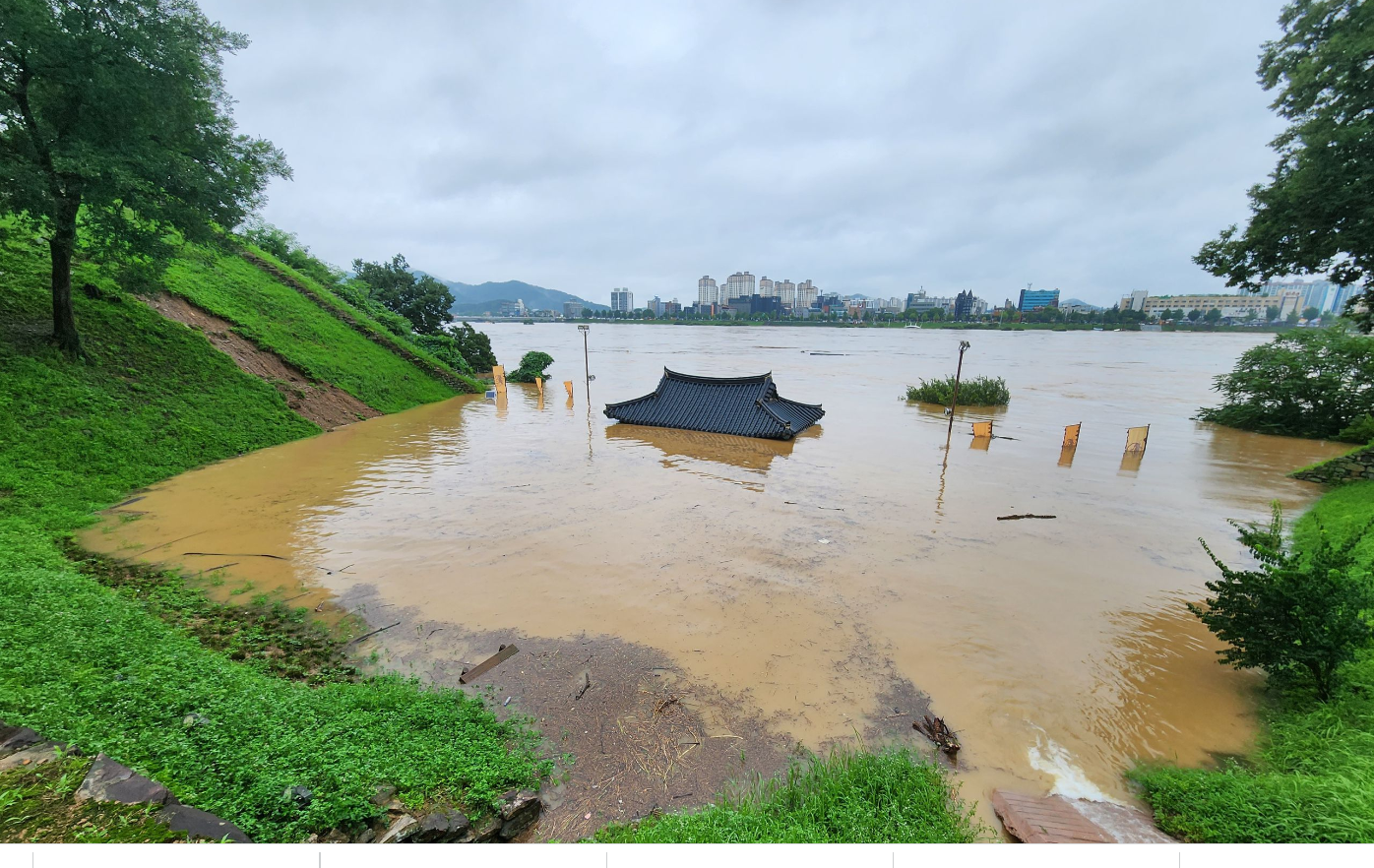
On July 15, 2023, heavy rains in the Chungcheongbuk-do region caused flooding, submerging Manharu in Gongju, Chungcheongnam-do (Historic Site No. 12) under water.
To stabilize food supplies amid climate volatility, the government will deploy agricultural satellites and AI-based monitoring systems and expand the development of climate-resilient crop varieties.
By 2030, officials aim to develop and distribute a cumulative 449 varieties resistant to pests, cold weather and other climate stresses.
The plan also emphasizes protection for climate-vulnerable populations. Nationwide surveys will be expanded to better identify risks faced by low-income households, the elderly and others, with support ranging from cooling shelters and energy cost relief to flood prevention measures.
For residents of disaster-prone housing, such as semi-basement units, the government will continue subsidies for flood barriers, public buyouts and relocation assistance.
Beginning next year, the government plans to introduce a form of “climate insurance” for outdoor public workers, including sanitation staff, who are exposed to extreme heat. The program would halt work during heat wave alerts and compensate workers for lost income, with details to be finalized through further research.
To address fragmented implementation across ministries, the climate ministry will act as a central coordinator, integrating scientific forecasting by agencies such as the weather service into administrative planning and budget decisions.
Officials said a dedicated climate adaptation law will be drafted next year to anchor the strategy in legislation, alongside reforms to incorporate future climate risks into fiscal policy.
“Climate change is affecting every aspect of daily life and increasingly threatening public safety,” said Lee Ho-hyun, the ministry’s second vice minister. “The government will build AI-based infrastructure and tailored climate safety nets to meet this challenge.”
Detailed implementation plans for the new strategy are expected to be completed by March, as the Democratic Party–led government seeks to institutionalize climate adaptation as a core pillar of national policy.
M. H. Lee (mhlee@koreabizwire.com)