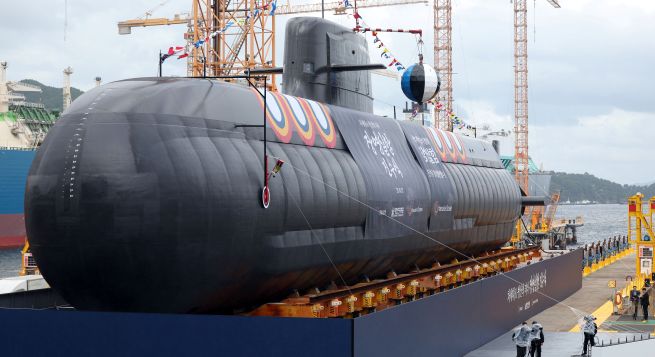
A view of the Jang Yeong-sil submarine (Jang Bogo-III, Batch-II No. 1), unveiled during its launching ceremony at Hanwha Ocean in Geoje, South Gyeongsang Province, on October 22. (Yonhap)
SEOUL, Nov. 5 (Korea Bizwire) — Defense Minister Ahn Gyu-back signaled support on Wednesday for constructing South Korea’s first nuclear-powered submarine at a domestic shipyard, arguing that the nation’s decades of shipbuilding expertise make it capable of managing such an ambitious defense project.
The comments come amid Seoul’s accelerating pursuit of a nuclear-powered submarine fleet—a capability long sought but never realized due to technological and diplomatic constraints. President Lee Jae Myung last week asked U.S. President Donald Trump to permit South Korea access to nuclear fuel for the program. Trump later announced that he had granted the request, describing diesel-powered vessels as “old-fashioned” and confirming that construction would take place at a U.S. shipyard owned by Hanwha Ocean, a South Korean firm.
Ahn, however, suggested that the project should remain at home. “It is only fitting, as we have accumulated the necessary research and technology over the past three decades,” he told lawmakers during a parliamentary defense committee session. He added that the U.S. shipyard in question faced “certain inadequacies” in its technical and human resources.
While Ahn noted that no final decision has been reached on where the submarine will be built, his remarks underscore a broader ambition: to strengthen South Korea’s defense autonomy and reduce dependence on U.S. production chains at a time when Washington’s export controls and technology restrictions have complicated allied cooperation.
The defense minister also confirmed “significant progress” in Seoul’s ongoing effort to reclaim wartime operational control (OPCON) from Washington—a long-standing goal intended to give South Korea command authority in the event of war. The two allies, he said, recognized Seoul’s growing capability to lead combined forces, with further details to be outlined in an upcoming joint communiqué following the release of a bilateral tariff fact sheet.
That document, expected soon, will likely include information on South Korea’s planned purchase of roughly $25 billion in U.S. defense equipment over the next five years.
For the Lee administration, the submarine project represents more than a military milestone. It is part of a broader recalibration of national defense policy—one that seeks both technological self-reliance and strategic balance within the evolving U.S.–China rivalry.
M. H. Lee (mhlee@koreabizwire.com)