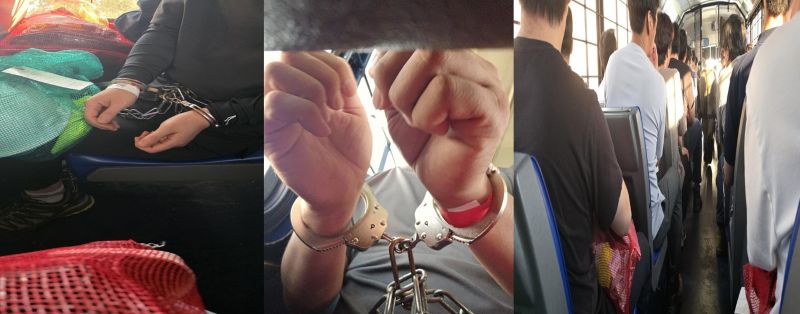
Workers in handcuffs and chains. Many of them were highly skilled technicians from South Korea’s elite universities, dispatched to help accelerate the early operation of the U.S. plant. (Image source: Worker A’s detention diary)
SEOUL, Sept. 16 (Korea Bizwire) — When Immigration and Customs Enforcement agents stormed a battery plant construction site in Bryan County, Georgia, earlier this month, hundreds of South Korean workers found themselves in shackles, held in freezing rooms with moldy mattresses and little explanation of what crime they had committed.
The episode, now reverberating across Seoul and Washington, has cast an uneasy spotlight on the intersection of two forces: the Biden administration’s aggressive stance on immigration enforcement and South Korea’s record-breaking corporate push into America’s electric vehicle supply chain.
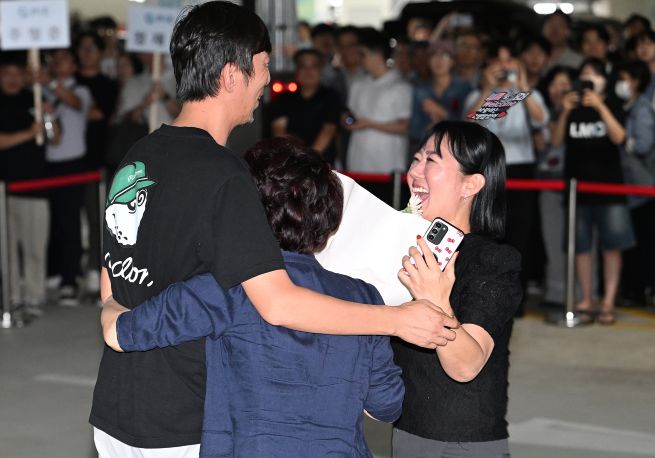
A South Korean worker who had been detained in Georgia by U.S. immigration authorities is reunited with family members in the parking lot after arriving through Terminal 2 of Incheon International Airport on September 12. They are among the engineers recognized as having top-tier technical expertise in South Korea. (Yonhap)
A Diary of Detention
The harrowing conditions were captured in a handwritten journal by one worker, identified only as Mr. A, who had traveled to the United States on a legal B-1 business visa. His notes, obtained by Yonhap News, describe how ICE agents rounded up helmeted and boot-clad workers, zip-tied their wrists, and forced them to fill out alien arrest forms without interpreters or Miranda rights.
Inside a 72-person holding room, detainees slept on mold-covered bunk beds without blankets or basic hygiene supplies. Water tasted foul; towels were scarce. To keep warm, some microwaved towels and draped them over their shoulders. Only days later were toothbrushes, deodorant, and blankets distributed.
“When I asked why I was being detained on a legal visa, one officer said, ‘I don’t know. Higher-ups think it’s illegal,’” Mr. A wrote. Another guard reportedly mocked detainees with references to “North Korea” and “Rocket Man.”
By the time they were released a week later, 316 South Koreans had been flown home on a chartered jet, stripped of their visas and unable to return to work.
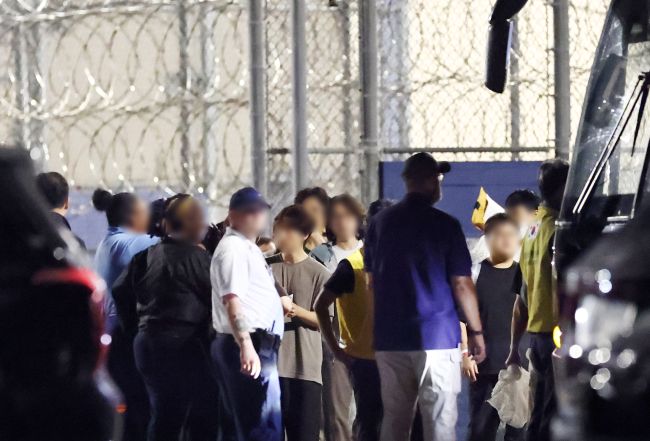
Detained workers from the Hyundai–LG battery plant construction site depart the ICE facility in Folkston, Georgia, en route to Atlanta Airport on September 11. (Image courtesy of Yonhap)
A Familiar Tactic, a New Target
Large-scale workplace raids are not new in the United States. During the George W. Bush administration, ICE conducted highly publicized raids on meatpacking plants and poultry factories, often arresting hundreds of undocumented workers in a single sweep. In 2019, federal agents stormed several chicken processing plants in Mississippi, detaining nearly 700 workers, one of the largest single-state immigration enforcement actions in U.S. history.
But the Georgia raid marked a sharp departure: the targets were not undocumented migrants from Latin America but skilled technicians from one of America’s closest allies, sent legally to oversee construction at a $6.3 billion joint venture between Hyundai Motor Group and LG Energy Solution.
“This was not the typical profile of an ICE raid,” said David Fitzgerald, a sociologist at UC San Diego who studies immigration enforcement. “When you detain workers on legal visas at a site tied to massive U.S. industrial policy, you are playing with fire diplomatically.”
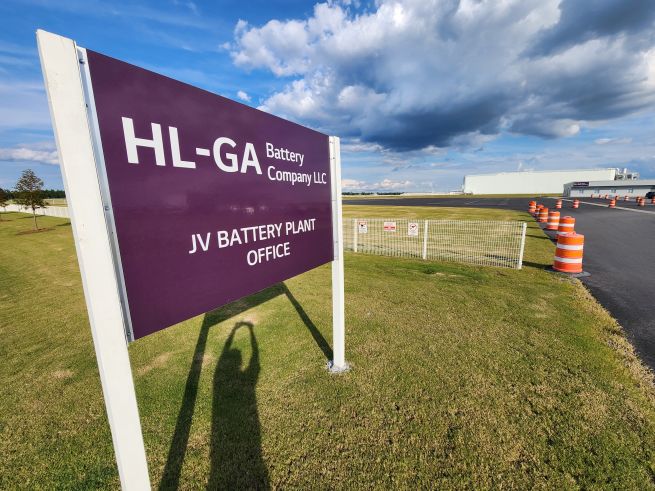
The construction site of the Hyundai Motor–LG Energy Solution battery plant in Ellabell, Bryan County, Georgia, on September 11 (local time). The site has remained deserted since construction was halted following a Department of Homeland Security crackdown on undocumented workers on September 4. (Yonhap)
Billions at Stake
For South Korea, the timing could hardly be worse. Hyundai and LG have poured billions into battery plants in Georgia and beyond, betting on long-term demand driven by Washington’s Inflation Reduction Act.
The HL-GA plant at the center of the raid is just one of several projects: Samsung SDI is building facilities with Stellantis and General Motors in Indiana; SK hynix has announced $3.8 billion for a semiconductor packaging site; and Hanwha is investing in U.S. shipyards.
Altogether, South Korean companies have pledged more than $150 billion in U.S. manufacturing projects — one of the largest foreign investment waves in recent history.
Now, executives in Seoul are reassessing their exposure. “This raid has created a chilling effect,” said Kim Hyeon-su, a trade policy expert in Seoul. “If visa compliance can be weaponized against legal workers, companies will think twice about scaling up.”
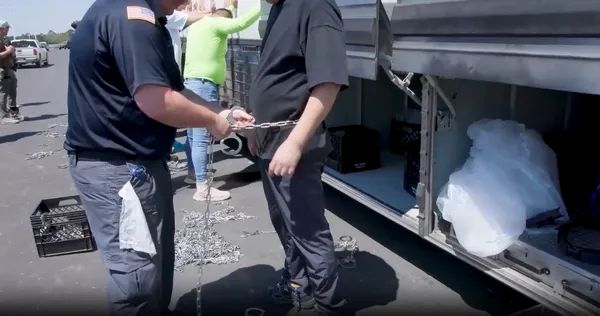
The U.S. Immigration and Customs Enforcement (ICE) on September 4 (local time) released footage of a raid targeting undocumented workers at the Hyundai Motor Group–LG Energy Solution joint battery plant site in Savannah, Georgia. (Image source: ICE website capture)
Human Rights at the Fore
The episode has also ignited debate in South Korea over the treatment of its nationals abroad. Accounts of detainees chained at the waist, wrists, and ankles, and herded into foul-smelling vans evoke imagery more often associated with criminal gangs than visiting engineers.
Consular officials who visited the detention site reportedly urged workers to sign “voluntary departure” papers, warning that fighting the charges could mean months or years in U.S. custody. For many Koreans, the advice came across as pragmatic but humiliating — a reflection of how little power Seoul wielded in the moment.
President Lee Jae Myung’s administration has since vowed to investigate possible human rights violations and pressed Washington to ensure such incidents do not recur. Human rights groups are urging both governments to review whether ICE’s tactics violated international norms.
“This is not just about Koreans,” said Park Jin-woo, director of the Migrant Solidarity Network in Seoul. “It’s about the precedent: if workers with valid visas can be treated this way, it undermines the very idea of legal labor mobility.”

At Gwanghwamun, the progressive group Candlelight Action gathered near the U.S. Embassy, denouncing the incident as a violation of national dignity. (Image courtesy of Candlelight Action)
A Strain on the Alliance
The United States has leaned heavily on South Korea to help secure supply chains for semiconductors, batteries, and clean energy — pillars of Washington’s industrial strategy against China. But the raid risks undermining that cooperation, just as Korean firms are grappling with U.S. protectionist tariffs that already put them at a disadvantage compared with Japanese rivals.
“South Korea’s companies are not investing in the U.S. out of charity,” said Scott Snyder of the Council on Foreign Relations. “They are there to profit. If they perceive the operating environment as hostile, both politically and operationally, it will have ripple effects.”
Aftermath and Reckoning
Back in Seoul, the workers who endured detention are still processing the trauma. “Human rights were missing from that place,” Mr. A wrote in his diary. “We were treated like criminals, not like people who came to work.”
For policymakers, the case has become a flashpoint in broader debates: how far should South Korea go in aligning with Washington’s industrial strategy? What protections can it demand for its citizens abroad? And how will it reconcile the tension between investment opportunity and vulnerability?
As Seoul presses for answers, the diary of a single detained worker may yet become a symbol of something larger — the human costs of geopolitics, borne not in summit rooms or trade deals, but in the suffocating confines of a detention cell in rural Georgia.
M. H. Lee (mhlee@koreabizwire.com)