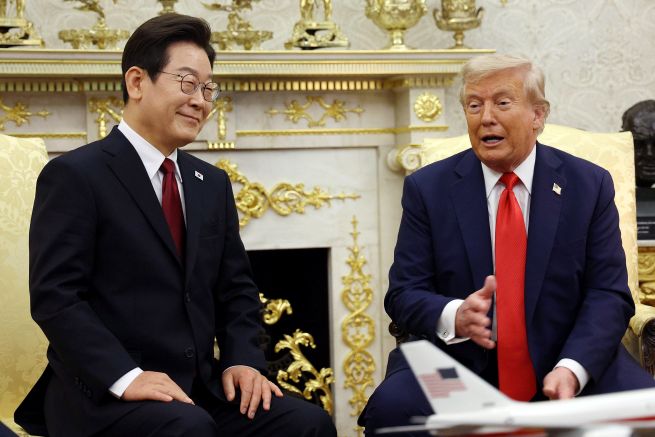
South Korean President Lee Jae Myung (L) holds talks with U.S. President Donald Trump in the Oval Office of the White House in Washington on Aug. 25, 2025. (Yonhap)
SEOUL, Aug. 26 (Korea Bizwire) — President Donald J. Trump suggested this week that the United States should seek ownership of land hosting American military bases in South Korea, a remark that unsettled officials in Seoul and fueled concerns that his brand of “new expansionism” could complicate the alliance.
During a summit with South Korean President Lee Jae-myung at the White House on Monday, Trump said the U.S. had “spent tremendous amounts of money building these bases” and questioned why Washington should remain limited to a lease arrangement. “I want that,” he said, referring to ownership of the land beneath the bases. “Let’s see if we can get rid of the lease and secure ownership.”
Under the Status of Forces Agreement, South Korea provides land for American bases with the explicit condition that it will be returned once no longer needed. The agreement stems from the 1953 Mutual Defense Treaty, which authorizes U.S. forces to be stationed in the South but affirms Korean sovereignty over the land.
Trump’s comments — made offhand while fielding a question about possible troop reductions — raised alarms because they challenged the bedrock terms of the alliance. Though he did not directly threaten to withdraw troops, observers said he appeared to hint that troop levels and base arrangements could become bargaining chips.
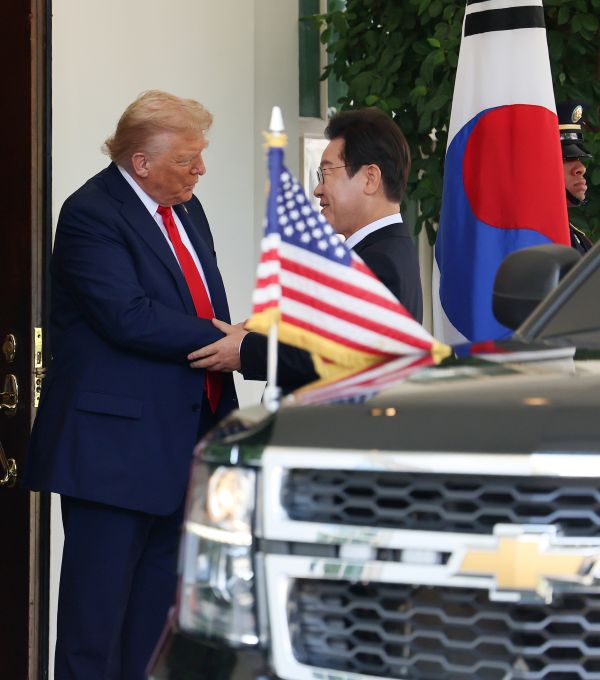
South Korean President Lee Jae Myung (R) is greeted by U.S. President Donald Trump ahead of their talks at the White House in Washington on Aug. 25, 2025. (Yonhap)
The remark fits a broader pattern of Trump’s provocative statements about foreign territory since returning to office in January. He has previously floated U.S. “ownership” of Gaza as part of a postwar reconstruction plan, suggested buying Greenland, raised the prospect of taking control of the Panama Canal, and joked about annexing Canada as the “51st state.”
Analysts say such rhetoric reflects both Trump’s transactional worldview and his background in real estate, framing international security commitments as assets that should yield direct returns.
The strategy also dovetails with his “America First” agenda, in which allies benefiting from U.S. protection are pressed for greater concessions — a logic he applied to Ukraine last year when tying military support to a mineral rights agreement.
Whether Trump will pursue the issue seriously remains unclear. He has dropped other expansionist suggestions once they drew sharp backlash. Some analysts believe his comment may be more of a negotiating tactic aimed at extracting concessions elsewhere. Still, if linked to discussions over troop levels, the idea could become a disruptive force in U.S.–Korea relations.
For now, Trump’s refusal to discuss troop reductions explicitly — saying only, “We’re friends, and that’s why I don’t want to talk about it now” — was seen in Seoul as a modest reassurance. But with the Pentagon still reviewing its global force posture, officials worry the question of bases and ownership could resurface.
M. H. Lee (mhlee@koreabizwire.com)