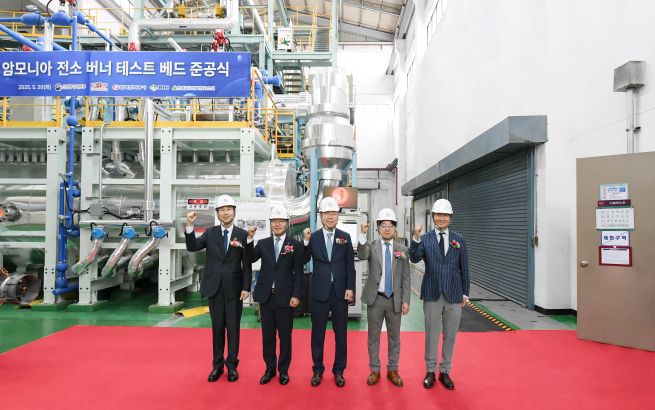
Completion ceremony of the ammonia combustion burner testbed (Photo provided by Korea Electric Power Corporation)
SEOUL, May 22 (Korea Bizwire) — Korea Electric Power Corporation (KEPCO) announced the completion of the country’s largest ammonia combustion testing facility on Tuesday, as the state-run utility accelerates efforts to commercialize carbon-neutral power generation technologies.
Located at KEPCO’s Power Research Institute, the new 1-megawatt testbed is designed to verify high-efficiency, low-emission combustion of ammonia—a next-generation clean fuel considered a key alternative in the global energy transition.
Ammonia is increasingly viewed as a promising zero-carbon energy carrier, particularly for co-firing with coal in existing power plants. KEPCO said the facility will support the development and eventual commercialization of ammonia-based power generation technologies, which are being positioned as a transitional solution for reducing carbon emissions in South Korea’s fossil fuel-heavy grid.
Data and technologies validated through the testbed will feed into upcoming demonstration projects. South Korea plans to gradually shift toward clean hydrogen sourced from renewables like solar and wind, with ammonia serving as a more efficient transport and storage medium for hydrogen imports.
Rather than leaping directly into 100% hydrogen-fueled turbines, KEPCO anticipates a phased approach involving blended combustion—mixing clean hydrogen or ammonia with existing fuels such as liquefied natural gas (LNG) or coal.
As part of this transition, KEPCO aims to replace 32 coal plant start-up burners with ammonia-only models by 2027 and initiate a full-scale demonstration of 20% ammonia co-firing at a 1,000-megawatt-class power station. The initiative is expected to cut carbon dioxide emissions by approximately 1 million tons annually.
“This facility marks a turning point in our drive to commercialize ammonia combustion technologies,” said Moon Il-joo, head of KEPCO’s Technology Innovation Division. “We are committed to accelerating the development of eco-friendly power solutions that will lead the carbon-neutral era.”
M. H. Lee (mhlee@koreabizwire.com)