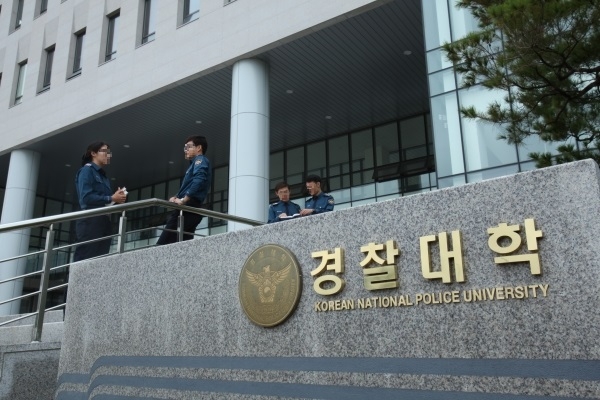
Korea National Police University students are having a conversation on campus. (Image courtesy of Korea National Police University)
SEOUL, May 26 (Korea Bizwire) — A growing number of South Korea’s elite police academy graduates are leaving their posts to enter law schools, raising questions about the integrity of public investment in the Korea National Police University (KNPU) and prompting calls for institutional reform.
This year alone, at least 81 KNPU alumni were admitted to law schools across the country—nearly matching the academy’s annual intake of 100 students. Many are exiting the force before fulfilling their six-year mandatory service commitment, opting instead to reimburse a portion of their publicly funded education and pursue careers as lawyers.
According to data from the National Police Agency, between 2021 and March 2025, a total of 143 KNPU graduates resigned early and repaid part of their education expenses.
Most had either passed the bar exam while still in service or were admitted to law school before leaving the force. Including those who departed after completing their service, the number of law school-related exits is believed to be significantly higher.
Under current rules, early resigning officers are required to repay a prorated portion of the approximately 86 million won ($63,000) in total education costs, which include tuition, housing, allowances, meals, uniforms, and textbooks.
Those who serve five of the six required years, for instance, owe less than 15 million won—a sum many see as a minor cost for entry into high-paying legal careers.

Exodus of Police Academy Graduates to Law Schools Sparks Scrutiny Over Public Funding and Reform Needs (Image supported by ChatGPT)
“Most don’t end up paying the full 80 million won,” said one police official. “Many see it as a good trade-off—just a few years in uniform for a lifelong legal career.”
With official leave for law school enrollment restricted, many officers reportedly balance academic coursework with their shifts, often volunteering for field posts like local police substations with flexible rotating schedules to attend classes.
Some observers defend the trend, citing constitutional freedoms and the value of legal expertise in police work. They argue that stagnant promotion prospects and poor working conditions are pushing even the most committed officers out of the system.
Still, critics warn that the exodus undermines the very purpose of the KNPU, which was established to train long-term police leadership. As more officers earn law degrees only to resign, concerns are mounting over the misuse of taxpayer-funded education.
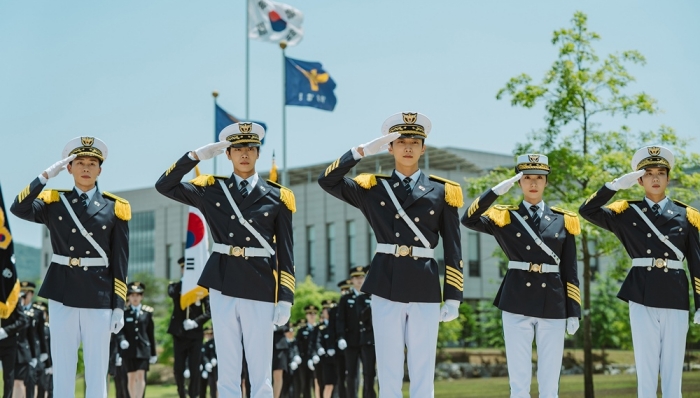
The photo is a scene from the 2021 KBS drama Police University. The series tells the story of a passionate detective who relies on brute strength and a brilliant former hacker-turned-criminal-justice student. They meet at the Korea National Police University as professor and student, teaming up for joint investigations. (Image courtesy of Logos Film)
Data provided by lawmaker Yang Boo-nam of the Democratic Party shows that as of May 2025, 49 active police officers—mostly KNPU graduates—had voluntarily registered their bar qualifications. In 2024 alone, 12 resigned after passing the bar, a sharp rise from just two in 2021.
“The repayment amount of just 10–20 million won is equivalent to one or two months’ salary at a top law firm,” said Lee Yoon-ho, a professor of police administration at Dongguk University. “It’s a negligible cost compared to the benefits they received.”
Lee urged reforms such as extending the mandatory service period or adjusting the reimbursement structure to reflect the true cost of public investment. “The KNPU and the police should not become mere stepping stones for personal advancement,” he said.
As the police academy faces a potential identity crisis, experts warn that unless systemic changes are made, even its continued existence could come under debate.
M. H. Lee (mhlee@koreabizwire.com)