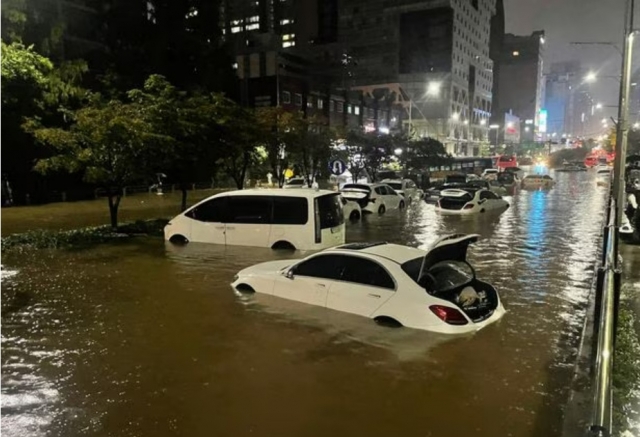
The road toward Gyodae at the Gangnam Station intersection in Seoul is seen flooded due to heavy rainfall on the night of August 8, 2022. (Photo courtesy of the Seoul Metropolitan Government)
SEOUL, May 29, 2025 (Korea Bizwire) — Despite having more flood infrastructure than rural areas, South Korea’s major cities such as Seoul, Incheon, and Busan are at higher risk of flooding, according to a new artificial intelligence-driven study.
A joint research team from Pohang University of Science and Technology (POSTECH) and Kyungpook National University used machine learning models to create a national flood risk map, concluding that highly urbanized areas with vast impermeable surfaces are particularly vulnerable to damage from increasingly erratic rainfall linked to climate change.
Unlike traditional flood risk assessments, which often rely on time-consuming expert judgment, the team analyzed two decades of flood damage data compiled by the Ministry of the Interior and Safety between 2002 and 2021.
They then categorized risk factors into four components — hazard, exposure, vulnerability, and adaptive capacity — and trained AI models to interpret them.
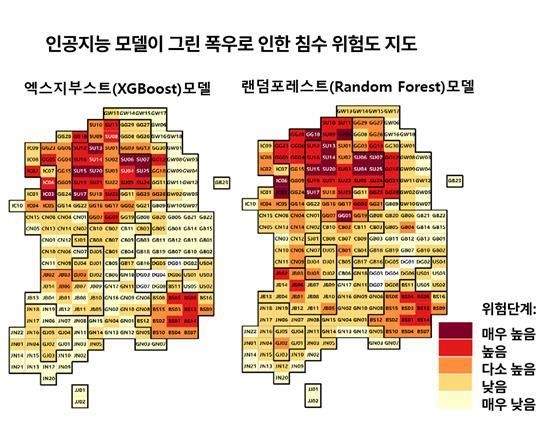
AI-based model-generated flood risk map of the Korean Peninsula due to heavy rainfall. (Image courtesy of POSTECH)
Two models — XGBoost and Random Forest — delivered prediction accuracies exceeding 77%. The XGBoost model identified the proportion of impervious surfaces, such as concrete pavement, as the most critical factor, while the Random Forest model highlighted river area.
Despite different primary indicators, both models flagged large cities as high-risk zones. Researchers attributed this to dense populations, extensive paved surfaces, and critical infrastructure located near rivers, which amplify potential flood damage.
To mitigate risk, the team recommends expanding green spaces that absorb rainwater and curbing development near waterways. These findings were published in the Journal of Environmental Management, a leading academic journal in environmental science.
Lead author Lee Eun-mi expressed hope that the study will help inform practical flood prevention strategies amid accelerating climate volatility.
M. H. Lee (mhlee@koreabizwire.com)