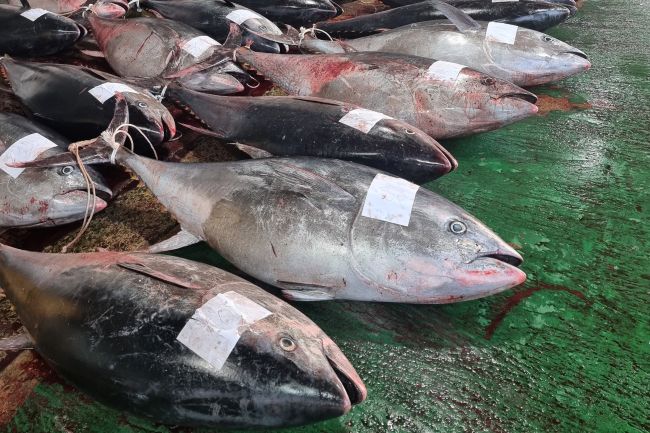
What was once dubbed the “lottery of the sea” has become a costly dilemma for South Korean fishermen along the country’s eastern coast. (Image courtesy of Yonhap)
YOUNGDEOK, July 10 (Korea Bizwire) — What was once dubbed the “lottery of the sea” has become a costly dilemma for South Korean fishermen along the country’s eastern coast. A surge in bluefin tuna catches, driven by changing sea temperatures, is clashing with outdated government-imposed fishing quotas, forcing fishermen to discard valuable catches — and raising concerns about marine pollution.
On Tuesday alone, more than 1,300 bluefin tuna, weighing an estimated 150 tons, were caught off the coast of Yeongdeok in North Gyeongsang Province. That single day’s haul already exceeded the region’s entire annual quota, set at 110 tons.
Under current regulations, any catch exceeding the quota must be discarded. With most of the fish arriving dead or dying after being entangled in nets for hours, throwing them back into the sea poses an environmental hazard. Fishermen say the situation is untenable.
“We have no choice but to discard them,” one local fisherman said. “It’s a waste, and it pollutes the ocean.”
The annual quota for the region — covering Yeongdeok, Uljin, Pohang, and Gyeongju — was increased modestly from 74.4 tons in 2022 to 110 tons this year, but the rise in tuna populations has far outpaced that adjustment. Market conditions have also shifted dramatically: once commanding over 33,000 won per kilogram (roughly $24), the flood of supply has depressed prices to as low as 2,000 won per kilogram.
The wasteful oversupply has created both economic and ecological headaches. In 2022, thousands of rotting tuna washed ashore near Jangsa Beach in Yeongdeok after being discarded due to quota limits, fouling the coast with stench and decay.
Fishermen are now urging the government to raise catch limits, offer financial compensation, or purchase the surplus stock directly to prevent further waste. Local authorities echo the call, warning that the status quo risks both economic harm and environmental damage.
“As long as we’re forced to discard excess catches, marine pollution will continue,” said an official from Yeongdeok County. “A realistic adjustment of quotas and policy alternatives are urgently needed.”
As climate patterns continue to alter migration routes and fish populations, South Korea’s fisheries policy faces mounting pressure to adapt — before the bounty of the sea turns fully into a blight.
M. H. Lee (mhlee@koreabizwire.com)