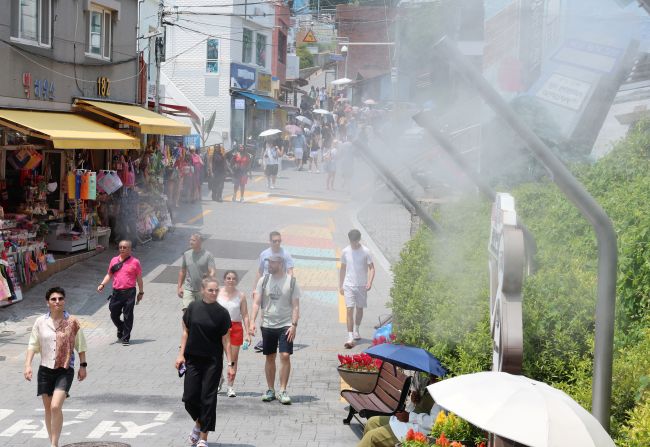
Foreign visitors cool off in sweltering weather in the southeastern port city of Busan on July 8, 2025, as most parts of the country remain under extreme heat warnings or advisories. (Image courtesy of Yonhap)
SEOUL, July 15 (Korea Bizwire) — As temperatures in parts of South Korea surged past 40°C again this summer, experts warn that extreme heat is no longer an anomaly, but a growing reality.
In response, the government is shifting its focus from prevention to adaptation, launching community-level initiatives to safeguard vulnerable populations.
On July 8, the cities of Gwangmyeong and Paju recorded daytime highs above 40°C — the second consecutive year South Korea has seen such extreme heat.
With scientists warning that climate change cannot be reversed, only mitigated, attention is turning toward survival strategies in an increasingly volatile environment.
The Ministry of Environment is spearheading a new initiative known as the Climate-Safe Village project, designed to support communities most at risk. Beginning next year, the ministry plans to expand its nationwide survey of climate-vulnerable groups and install climate-adaptive infrastructure — such as heat shelters and thermal-reflective coatings on rooftops and exterior walls — based on local needs.
While the ministry has previously funded individual projects, such as shelters for outdoor workers and building modifications, officials acknowledge these fragmented efforts had limited impact. The new model will combine measures into comprehensive, tailored packages informed by data and community feedback.
“This is about analyzing the specific climate risks facing a neighborhood and responding with the right mix of infrastructure,” a ministry official said. “We’re aiming for locally customized solutions that reflect what residents actually need.”
The urgency is underscored by Korea Meteorological Administration data showing that the national average temperature for the first 10 days of July reached 28.2°C — the highest ever recorded for that period since comprehensive nationwide observations began in 1973. It is the first time the early July average has exceeded 28°C.
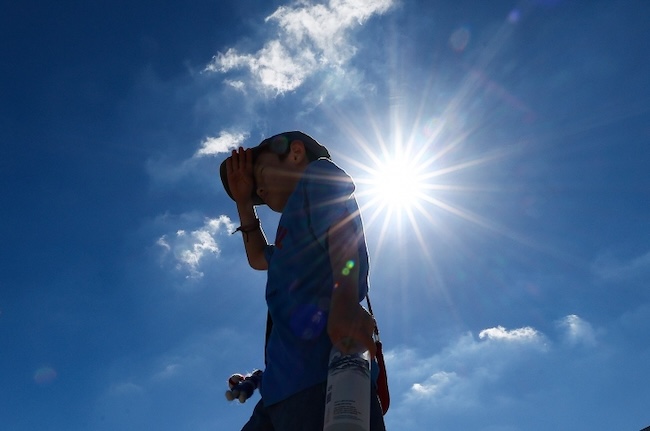
The summer heat (Image courtesy of Yonhap)
Although more analysis is needed to directly attribute this spike to climate change, the long-term trend is clear: July’s average temperature has risen 1.1°C over the past 52 years.
Projections from the national Regional Climate Change Outlook Report paint an even starker future. Even under the most optimistic scenario (SSP1-2.6), where fossil fuel use is minimized and sustainable growth prevails, the number of extreme heat days is expected to rise significantly.
From a current range of 4.8 to 32.4 days annually across 17 provinces, heatwave days could climb to as many as 60.5 by the end of the century.
Peak annual temperatures, which now range from 33.9°C to 37.3°C, could increase to between 35.0°C and 40.8°C by the late 21st century — making the recent highs a glimpse of a rapidly approaching norm.
As South Korea braces for a hotter future, the shift toward climate adaptation marks a sobering but necessary pivot in national policy — one that accepts the heat is here to stay.
M. H. Lee (mhlee@koreabizwire.com)