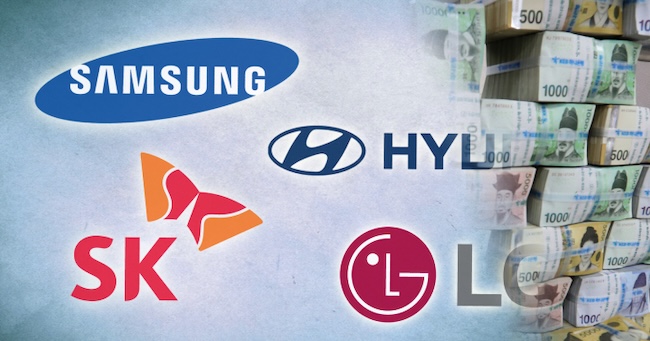
This image shows the logos of South Korea’s top four conglomerates. (Image courtesy of Yonhap)
SEOUL, July 15 (Korea Bizwire) — South Korea’s powerful business conglomerates, or chaebol, continued a controversial pattern in 2023: funneling excessive dividends to owner families through privately held affiliates, some of which posted losses, prompting renewed concerns over shareholder inequality and market distortion.
According to audit reports filed with the Financial Supervisory Service and reviewed by The Korea Times, top-ranking chaebol groups—including GS, Kakao, Booyoung, and Harim—distributed massive dividends through unlisted subsidiaries, in some cases exceeding their net profits.
Outsized Dividends to Owner Families
GS Group’s unlisted affiliate Samyang International paid out 10 billion won in dividends, surpassing its annual net profit of 9.19 billion won. Most of this cash reportedly went to fourth-generation members of the GS founding family, including CEO Heo Jun-hong.
Similarly, GS heirs received 5.2 billion won from Samjeong Construction and 8 billion won from Seungsan. Kakao founder Kim Beom-soo’s 100%-owned K Cube Holdings, despite recording a net loss of 3.35 billion won, issued 15 billion won in dividends—a payout ratio of minus 447%. A year earlier, it had paid out 60 billion won. Kakao said the funds were intended to support Kim’s pledge to donate half of his wealth.
Booyoung Chairman Lee Joong-keun and his son received a combined 19.4 billion won from unlisted affiliate Gwangyeong Construction—again, exceeding the company’s net profit. Harim Group’s poultry firm Orpum and Hyosung Group’s Hyosung Investment & Development followed similar patterns, with payouts surpassing net income.
(Image courtesy of Yonhap)
Concerns Over Shareholder Rights and Market Fairness
Critics say such practices amount to “dividend tunneling”—a form of private enrichment at the expense of public shareholders. These arrangements often involve directing lucrative business to privately held subsidiaries where chaebol families have direct control, draining profits from listed companies and eroding their dividend capacity.
“This is essentially privatizing corporate profits,” said Chung Ui-jung, head of the Korea Stockholders Alliance. “Ordinary investors who believe in these companies lose out while controlling families enrich themselves through side channels.”
Others warn that this internal favoritism distorts competition by denying small and mid-sized enterprises (SMEs) fair access to lucrative contracts, undermining public policies designed to support SME growth and innovation.
Calls for Legal and Regulatory Reform
Experts point to weak board oversight and limited disclosure requirements for unlisted firms as root causes. “Unless there are whistleblower reports or strong internal governance, it’s nearly impossible to detect these abuses,” said Lee Ho-seop, a researcher at the Korea Capital Market Institute. “In many cases, boards merely rubber-stamp the decisions of controlling families.”
Unlisted affiliates are subject to looser transparency rules than their listed counterparts, making it easier for families to extract value with minimal scrutiny. Financial analysts are calling for reforms that would strengthen board monitoring and introduce monetary penalties for questionable intra-group transactions.
“There needs to be real financial disincentives for abuse,” said Lee. “We should also significantly raise rewards for insider whistleblowers.”
The Yoon administration’s pending amendments to the Commercial Act have raised expectations for change. If passed, the new law would expand liability for breaches of fiduciary duty and make shareholder derivative lawsuits more accessible.
“For these reforms to be effective, they must be backed by strong financial penalties for violations,” Lee added. “Otherwise, the same old practices will continue unchecked.”
As scrutiny grows, reform advocates argue that without transparency and accountability—especially in the shadowy spaces of unlisted affiliates—the broader health of Korea’s corporate landscape remains at risk.
M. H. Lee (mhlee@koreabizwire.com)