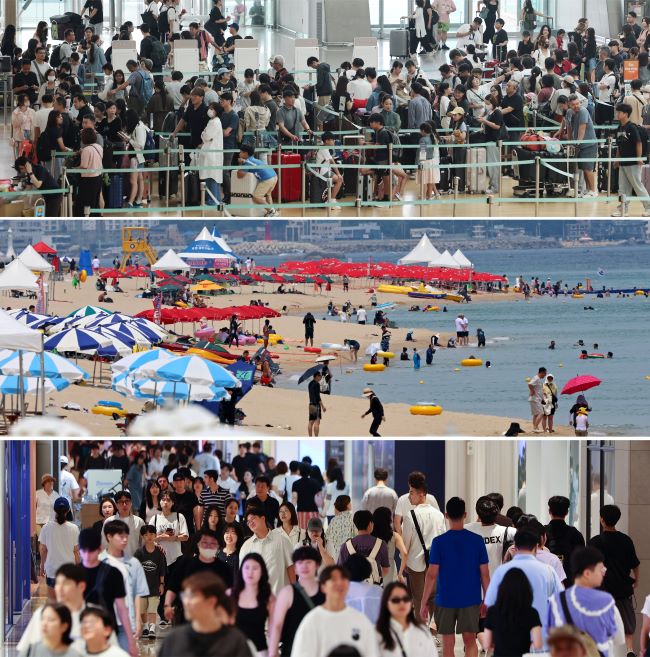
To avoid the scorching summer, many are turning to overseas destinations, seaside resorts, or indoor attractions. (Image courtesy of Yonahp)
SEOUL, July 23 (Korea Bizwire) — South Koreans report lower satisfaction with domestic travel compared to overseas vacations, primarily due to high local prices and a lack of distinctive tourist content, according to a new survey released by the Korea Economic Research Institute on Monday.
The nationwide survey, conducted by Mono Research, polled 1,000 adults who had traveled both domestically and abroad within the past three years. Respondents rated their overall satisfaction with domestic travel at 8.3 out of 10, trailing behind overseas travel, which scored 8.7.
Key reasons cited for the lower domestic travel satisfaction included inflated prices at tourist sites (45.1%), a lack of unique regional attractions (19.4%), and the concentration of tourism in a few select areas (9.0%).
Of 11 categories used to assess travel experiences, domestic trips scored higher than overseas only in transportation accessibility, tourist convenience facilities, and food. In contrast, foreign destinations outperformed in eight areas, including natural scenery, historical and cultural assets, festivals and events, experiential programs, leisure facilities, shopping, and accommodations.
For instance, 43.6% rated overseas destinations superior for natural landscapes, compared to just 12.5% for domestic locations.
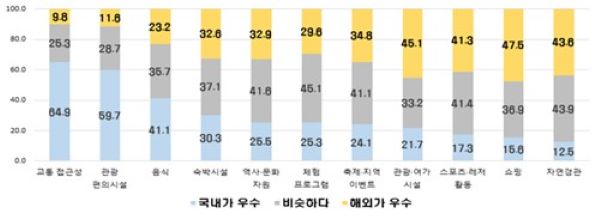
Travel Satisfaction by Tourism Factor: Domestic vs. International Destinations (Image courtesy of the Federation of Korean Industries)
Despite these perceptions, 87.6% of respondents still plan to travel within Korea this year, compared to 60.4% who anticipate going abroad. However, the average domestic trip expenditure (543,000 won) is only about a quarter of that for overseas trips (1.98 million won).
Travel preferences varied notably by age. Overseas travel was favored most among those in their 20s or younger (48.3%), followed by those in their 30s (45.9%). Conversely, domestic travel was more popular among older demographics, particularly those in their 50s (42.7%) and 60s (42.4%).
Respondents cited affordability (32.8%), convenience (30.1%), and cultural familiarity (9.4%) as reasons for favoring domestic travel. Meanwhile, those preferring overseas trips pointed to the appeal of novel experiences (39.1%), a wider variety of attractions (28.1%), and better value for money (14.8%).
To improve the appeal of domestic travel, respondents recommended stronger regulation to curb overpricing (35.6%), development of unique regional attractions (18.6%), improved public transportation links to tourist destinations (16.2%), and increased financial incentives like local travel vouchers (11.3%).
“Boosting domestic tourism can play a vital role in supporting regional economies and revitalizing domestic consumption,” said Lee Sang-ho, head of KERI’s Economic and Industrial Policy Division. “Efforts must be made to enhance the appeal and competitiveness of traveling within Korea.”
Lina Jang (linajang@koreabizwire.com)