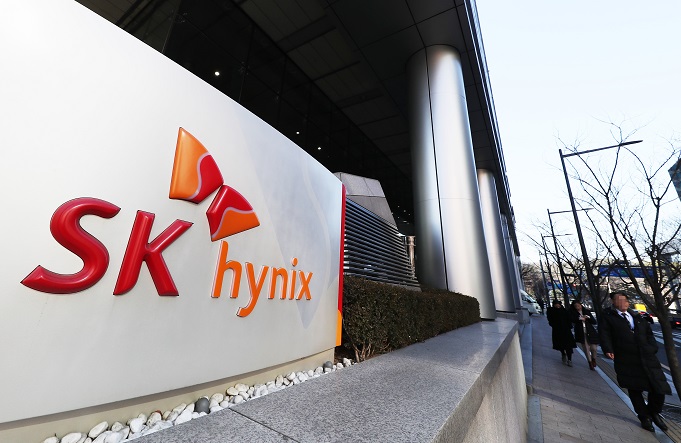
The entrance to SK hynix in Seongnam, south of Seoul. (Image courtesy of Yonhap)
SEOUL, July 24 (Korea Bizwire) – South Korean chipmaking giant SK hynix Inc. said Thursday its second-quarter operating profit surpassed 9 trillion won (US$6.53 billion) for the first time, driven by booming demand for artificial intelligence (AI) chips, including high bandwidth memory (HBM).
In a regulatory filing, the company reported an operating profit of a record 9.21 trillion won for the April-June period, up 68.5 percent from a year ago, setting a new quarterly record.
Revenue jumped 35.4 percent on-year to 22.23 trillion won, while net income soared 69.8 percent to 6.99 trillion won.
Both operating profit and sales exceeded the previous all-time highs set in the fourth quarter of last year.
SK hynix shares closed up 0.19 percent at 269,500 won Thursday on the back of robust earnings, while the broader Korea Composite Stock Price Index (KOSPI) ended 0.21 percent higher.
SK hynix attributed the record-breaking performance to robust AI-related demand, solidifying its status as a world leader in HBM technology.
“Aggressive investments by global big tech companies in AI led to a steady increase in demand for AI memory,” the company said in a statement. “Shipments of both DRAM and NAND flash were higher than expected, helping the company log the best quarterly results in its history.”
It said sales of its 12-layer HBM3E products and NAND flash memory expanded in the second quarter, contributing to a positive earnings trend, led by its “industry-leading competitiveness in AI memory and profitability-first management discipline.”
SK hynix noted that the inventory level remained stable in the three-month period ending in June on increased memory orders and shipments of finished products.
In the second half, demand for memory is expected to continue growing as major customers have plans to launch new products.
The company also forecast stronger demand for high-performance and high-capacity memory chips amid intensifying global competition to enhance AI model inference capabilities.
Ongoing investments by nations to build sovereign AI infrastructure are also expected to generate long-term memory demand, it added.
To meet the growing need, SK hynix said it plans to double its HBM output this year, leveraging its production capabilities and outstanding performance of its products.
It also said it will be ready to provide HBM4, the sixth-generation HBM, based on customer timelines to stay competitive in the AI memory race.
In addition, SK hynix said some of this year’s planned investments will be frontloaded to facilitate a smoother supply of key products, including HBM, in 2026.
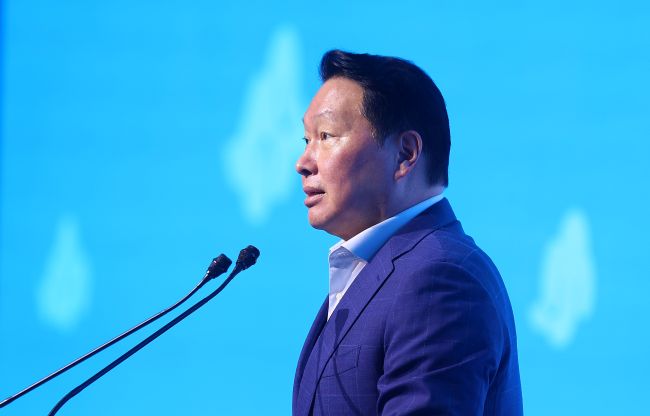
In this file photo taken July 16, 2025, Chey Tae-won, chairman of South Korea’s SK Group, delivers the opening speech at a summer forum hosted by the Korea Chamber of Commerce and Industry (KCCI) at a hotel in Gyeongju, about 275 kilometers southeast of Seoul. (Image courtesy of Yonhap)
“We are on track to meet our goal as a ‘full stack AI memory provider,’ satisfying customers and leading the market expansion through the timely launch of products with best-in-class quality and performance required by the AI ecosystem,” said Song Hyun-jong, president and head of the Corporate Center at SK hynix.
Regarding concerns over a potential decline in chip demand in the second half, following higher-than-expected supply in the first half, the company projected no significant change in demand for the remainder of the year.
“In the second quarter, memory suppliers, including SK hynix, and their clients maintained low inventory levels due to strong product demand. As a result, production in the second half is expected to lead to increased supply,” said Kim Kyu-hyun, head of the DRAM Marketing division, during the company’s earnings conference call.
When asked about its operations in China, SK hynix said it will continue running its Chinese plants in compliance with U.S. trade regulations, emphasizing its manufacturing facilities in China are “very important” to the business.
SK hynix currently operates plants in South Korea and China.
(Yonhap)