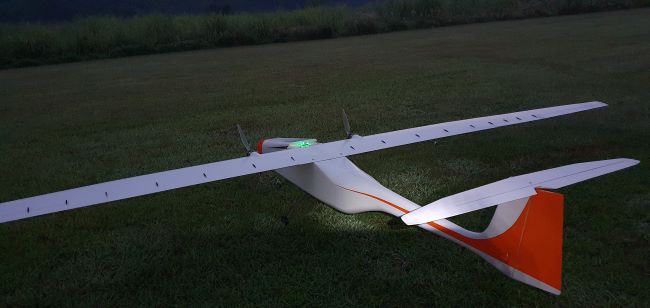
A South Korean research team has successfully completed a 12-hour continuous flight using a domestically developed hydrogen fuel cell-powered drone. (Image courtesy of KIMS)
Breakthrough marks milestone in long-endurance unmanned aerial technology using homegrown hydrogen fuel cell
SEOUL, Aug. 5 (Korea Bizwire)— A South Korean research team has successfully completed a 12-hour continuous flight using a domestically developed hydrogen fuel cell-powered drone, setting a new national benchmark for unmanned aerial vehicle (UAV) endurance, the Korea Institute of Materials Science (KIMS) announced Monday.
The milestone was achieved by Dr. Yang Cheol-nam’s team at KIMS’s Aerospace Materials Validation Center, which developed a 1.2kW-class fuel cell system tailored for UAVs. The aircraft, a 3.7-meter-long fixed-wing drone with a 7.6-meter wingspan and hybrid power configuration combining hydrogen fuel and batteries, covered a total distance of 755.6 kilometers during the test flight.
This marks the longest flight time ever recorded in South Korea for a UAV powered by domestically developed fuel cell technology, surpassing the team’s previous record of 11 hours set in 2023. The flight demonstrated a sustained average power output of 655 watts and an energy density of 606 watt-hours per kilogram.
Conventional battery-powered drones are limited by low energy density, while internal combustion engines, though capable of longer flights, suffer from high noise, vibration, emissions, and inefficiency. The KIMS team focused on overcoming these limitations by developing an efficient, low-noise, low-thermal-signature fuel cell system with potential for both military and civilian applications.
KIMS expects the technology to be useful for long-range aerial photography, coastal and inland surveillance, infrastructure monitoring, and military reconnaissance missions. The fuel cell’s quiet operation and low detectability make it especially promising for stealth operations.
Dr. Yang said the team’s next goal is to develop liquid hydrogen-compatible systems and high-density fuel cell stacks to enable 24-hour continuous flight. “We believe this innovation will play a critical role in advancing South Korea’s self-reliance in UAV technology,” he added.
Kevin Lee (kevinlee@koreabizwire.com)