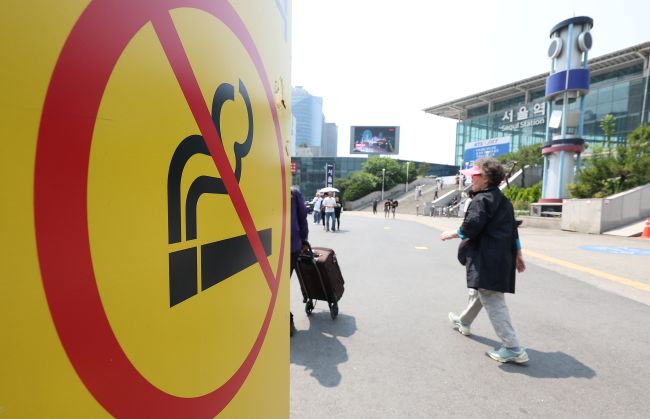
Effective from the 1st, Seoul Station Plaza and surrounding streets are designated as no-smoking zones. A fine of 100,000 KRW will be imposed for violations. (Image courtesy of Yonhap)
SEOUL, Aug. 19 (Korea Bizwire) – A government policy aimed at reducing smoking through tobacco tax increases appears to have only short-term impact, with a recent study revealing that the sales drop triggered by higher prices typically vanishes within four months.
According to a new report released Monday by the Korea Institute for Health and Social Affairs, smokers in South Korea exhibit highly inelastic demand — meaning that even significant price hikes result in only modest declines in cigarette consumption.
The report analyzed sales data before and after tax increases, finding that while sales initially dip, they quickly return to prior levels as consumers adjust.
The study estimated cigarette price elasticity at between -0.42 and -0.44, indicating that a 10% price increase leads to only a 4.2–4.4% drop in consumption. Non-price factors, such as graphic warning labels or the emergence of e-cigarettes, were found to have statistically negligible effects on overall demand.
Researchers argue that relying solely on one-off tax hikes is ineffective and unsustainable. Instead, they advocate for a more systematic “inflation indexation” model — tying tobacco price increases to consumer inflation and applying modest, predictable hikes annually.
This approach, the authors say, would avoid sudden shocks to the market while maintaining long-term deterrent effects.

A smoking booth installed in Euljiro, Seoul (Photo courtesy of Seoul Metropolitan Government).
“Sudden hikes result in hoarding and brief behavioral change, but smokers adapt,” the report states. “Incremental increases aligned with inflation are more likely to gradually shift consumption patterns and reinforce anti-smoking behavior.”
Still, researchers caution that price mechanisms alone are insufficient to curb smoking rates. They recommend a multipronged strategy that includes reducing nicotine content to lower addiction potential, and strengthening public campaigns like the Ministry of Health and Welfare’s “No Smoking” initiative launched in 2020.
The findings underscore the limitations of current anti-smoking strategies and suggest a pivot toward more consistent, evidence-based interventions is needed to achieve lasting public health gains.
M. H. Lee (mhlee@koreabizwire.com)