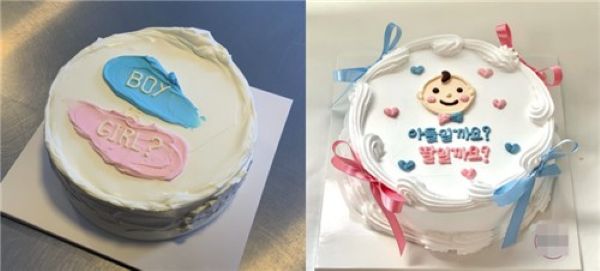
Gender reveal cake that reveals the baby’s sex through its inner color (Image captured from Instagram ‘jofreecake’ by cake studio)
SEOUL, Aug. 21 (Korea Bizwire) — As South Korea’s millennial and Gen Z generations begin raising families, pregnancy and childbirth are taking on new cultural forms, blending tradition, technology and social media.
Once marked by simple customs — such as hanging peppers or charcoal on a straw rope outside a home to signal the birth of a boy or girl — the act of announcing a baby’s sex has evolved into the American-imported “gender reveal” party.
Parents now gather friends and relatives to cut into cakes filled with pink or blue cream, or burst balloons stuffed with confetti, turning a once-private moment into a shareable celebration.
The trend has surged since a 2024 Constitutional Court ruling lifted a restriction that barred doctors from disclosing a fetus’s sex before 32 weeks of pregnancy. Searches for “gender reveal” in Korean spiked this year on Google, reflecting how quickly the practice has spread.
Critics warn that reinforcing gender stereotypes through color-coded rituals risks narrowing cultural views, but many young parents embrace the parties as affordable, memorable milestones and Instagram-ready content.
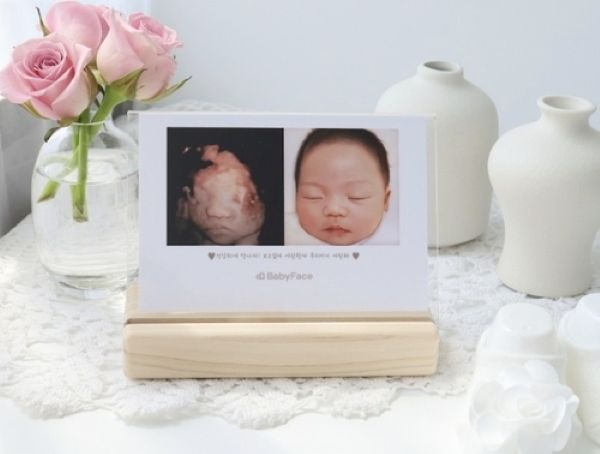
AI-generated fetal face previews . (Image courtesy of BabyFace.ai)
Equally visible are maternity photos. Once considered immodest, “D-line” portraits — highlighting a pregnant belly — are now commonplace, with more than 800,000 posts tagged on Instagram.
Inspired by celebrity shoots abroad and amplified by Korean influencers, couples are visiting photo studios or even taking self-portraits to document pregnancy as a moment of pride.
Bikini-clad maternity shots and stylish pregnancy wardrobes, from workout wear to tailored dresses, reflect the normalization of pregnant bodies in public life.
Technology is also reshaping expectations. Ultrasound images fed into generative AI tools can produce eerily realistic baby face predictions, with some parents paying for premium services.
Online forums are filled with prompts like, “This is a 30-week ultrasound of a Korean baby girl. Please render her face as realistically as possible.” Others turn to AI to interpret symbolic “dreams of conception” or even generate illustrated versions of them.
For some, the results foster a deeper emotional bond. “I wasn’t sure I felt maternal instinct, but seeing my baby’s face made it real,” said one expectant mother, 34 weeks pregnant.
The shift comes as South Korea, long burdened with the world’s lowest fertility rate, recorded a slight rebound last year.
The total fertility rate inched up to 0.75 in 2024, with government officials suggesting it could climb further this year as post-pandemic weddings and births pick up and more of those born in the early 1990s reach childbearing age.
In a nation where childbirth is often framed in terms of demographic crisis, young parents are finding new ways to celebrate beginnings — not with anxiety, but with creativity, spectacle and technology.
Lina Jang (linajang@koreabizwire.com)