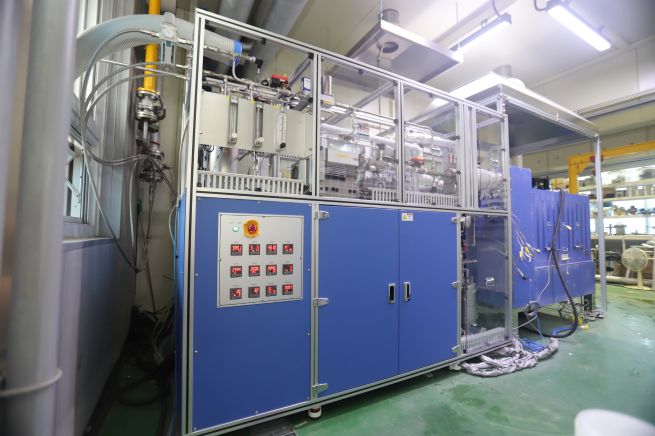
20kW-class fuel electrode-supported solid oxide electrolysis system (Photo courtesy of the Korea Institute of Machinery and Materials)
DAEJEON, Sept. 30 (Korea Bizwire) — South Korean scientists have unveiled the country’s first system capable of producing clean hydrogen at significantly lower costs, a development that could accelerate the nation’s transition to renewable energy.
The Korea Institute of Machinery and Materials (KIMM) said Monday that a research team led by principal researcher Kim Young-sang has successfully developed a 20-kilowatt-class solid oxide electrolysis (SOE) system.
The technology uses electricity and steam at temperatures above 700 degrees Celsius to produce hydrogen more efficiently than conventional low-temperature methods.
By integrating waste heat from industrial sites into the process, the system reduces the additional electricity needed to generate steam, cutting overall power consumption by more than 15 percent compared with existing electrolysis technologies.
Tests showed that the system achieved an electrical efficiency of 83 percent—among the highest recorded—while producing six cubic meters of hydrogen per hour.
The research team also operated the system continuously for more than 3,000 hours, proving its stability even under disruptions such as irregular steam supply or power outages.
Based on these results, KIMM estimates that the technology could lower hydrogen production costs to around 3,000 won ($2.15) per kilogram, more than 25 percent cheaper than using industrial electricity alone.
“This marks the first time in Korea that solid oxide electrolysis technology, previously limited to cell and stack levels, has been scaled up and verified at the system level,” Kim said. “We have secured the design foundation for high-efficiency, low-cost clean hydrogen production.”
The breakthrough could be a crucial step in South Korea’s effort to expand hydrogen’s role in its energy mix, particularly through the use of waste heat, nuclear power and renewables to fuel hydrogen production.
Kevin Lee (kevinlee@koreabizwire.com)



![[In-depth] Top Ten Fashion Trends in 2014 Selected by the Korea Fashion Association](http://koreabizwire.com/wp/wp-content/uploads/2014/12/nonagon-370x230.jpg "[In-depth] Top Ten Fashion Trends in 2014 Selected by the Korea Fashion Association")