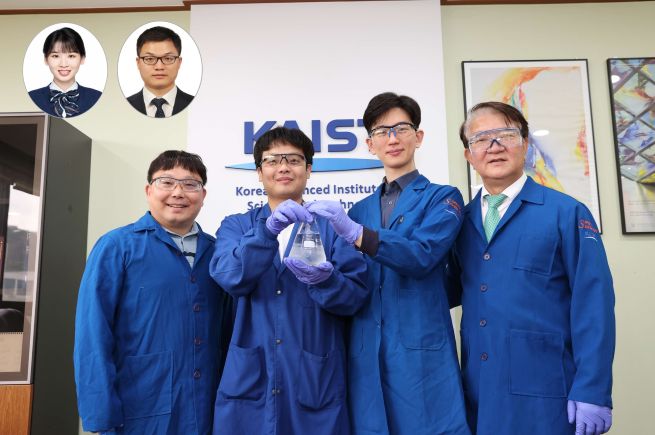
KAIST research team that produced BTEX using a microbial process: The team was led by Professors Han Soon-kyu (far left) and Lee Sang-yup (far right). (Photo courtesy of KAIST)
DAEJEON, Oct. 13 (Korea Bizwire) — In a breakthrough that could transform the petrochemical industry, a South Korean research team has developed a sustainable technology to produce key industrial chemicals without using petroleum.
KAIST announced Sunday that Distinguished Professor Lee Sang-yup of the Department of Chemical and Biomolecular Engineering and Professor Han Soon-kyu of the Department of Chemistry have jointly created a process that synthesizes benzene, toluene, ethylbenzene, and xylene — collectively known as BTEX — from renewable bio-based materials.
BTEX compounds are essential feedstocks for producing plastics, fibers, solvents, and pharmaceuticals. Traditionally derived from crude oil refining, they have long been considered difficult to reproduce from plant-based sources due to their complex molecular structures.
The KAIST team overcame this challenge by combining microbial fermentation with organic chemical reactions. Using glucose derived from biomass such as waste wood, engineered microorganisms first convert sugars and glycerol into oxygenated intermediates like phenol and benzyl alcohol. A subsequent chemical reaction removes oxygen atoms to yield BTEX compounds.
The researchers employed “systems metabolic engineering,” a technique pioneered by Professor Lee, to optimize the microbes’ glucose conversion efficiency. They also introduced a solvent called isopropyl myristate (IPM), which enables BTEX to be separated and recycled easily without lengthy purification steps.
“This achievement shows that microbial and chemical processes can work seamlessly within the IPM solvent system,” Professor Han said. “It provides a practical and sustainable alternative to petroleum-based production.”
Professor Lee emphasized the broader implications: “Global demand for BTEX continues to rise, and this technology offers a path to lower oil dependency and reduce the carbon footprint of the fuel and chemical industries.”
The study was published on October 2 in the Proceedings of the National Academy of Sciences (PNAS).
Kevin Lee (kevinlee@koreabizwire.com)