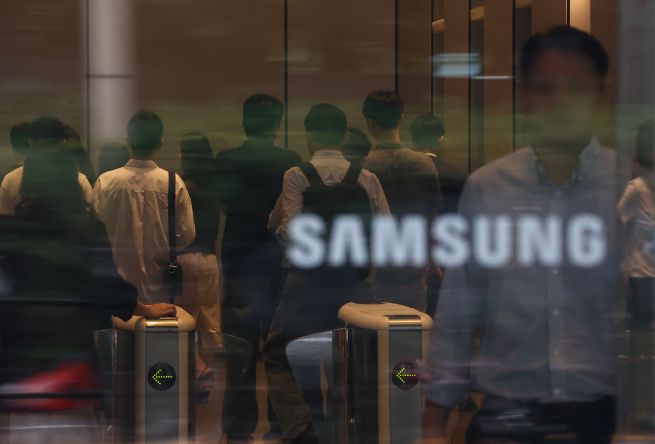
Samsung Electronics employees arrive for work at the company’s Seocho headquarters in Seoul. (Yonhap)
SEOUL, Oct. 13 (Korea Bizwire) — As Samsung Electronics grapples with a prolonged semiconductor downturn, its labor union has come under criticism for publishing content that favorably compares rival SK Hynix to its own employer, a move some observers say could further dent morale inside the tech giant.
The SELU branch of Samsung Electronics under the Samsung Group National Labor Union recently posted the first in a four-part interview series with former Samsung employees who moved to SK Hynix, featuring one worker who claimed that he suffered from depression and felt undervalued at Samsung but recovered after joining its rival.
The interview, shared on the union’s website and internal forums, described SK Hynix as a place where “hard work alone earns recognition,” contrasting it with what the worker called Samsung’s hierarchy-driven culture.
The former employee also said his salary had tripled since switching companies and criticized Samsung’s performance-based bonus system as “arbitrary,” while praising SK Hynix for narrowing pay gaps and compensating for wage reversals.
The union has announced plans to release three more installments of similar interviews.
Last month, the same union drew controversy for conducting an informal survey at Sungkyunkwan University — a Samsung-affiliated institution — that asked students to choose between working at Samsung Electronics or SK Hynix.
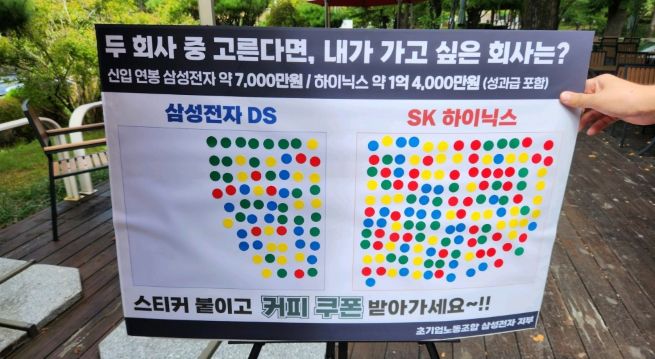
A survey conducted by the Samsung Electronics Labor Union (SELU) under the Samsung Group National Union at Sungkyunkwan University shows the question, “Between the two companies, which one would you like to join?” with significantly more stickers placed on the SK Hynix side. (Photo captured from SELU’s official website)
The survey, displayed near the engineering building, included claims that entry-level pay at Samsung was about 70 million won compared with SK Hynix’s 140 million won, a comparison critics said was misleading because it factored in variable bonuses.
The union later publicized the results, saying 67 respondents chose Samsung while 140 picked SK Hynix — and argued that the findings underscored Samsung’s need to reform its compensation and evaluation systems to attract top talent.
While some industry insiders acknowledge that the union’s actions stem from a legitimate desire to improve working conditions, others warn that comparing the company to its chief competitor risks undermining internal cohesion at a time when South Korea’s chip sector faces mounting global competition.
“Semiconductors are a national battleground involving the U.S. and China,” said one industry official. “Fair pay and transparent evaluation are critical issues, but disparaging your own company to elevate a rival helps no one.”
Some analysts also view the campaign as an attempt by the cross-company Samsung Electronics chapter to expand influence following internal rifts within the broader national union, which recently lost thousands of members over disputes about bonus negotiations.
Kevin Lee (kevinlee@koreabizwire.com)