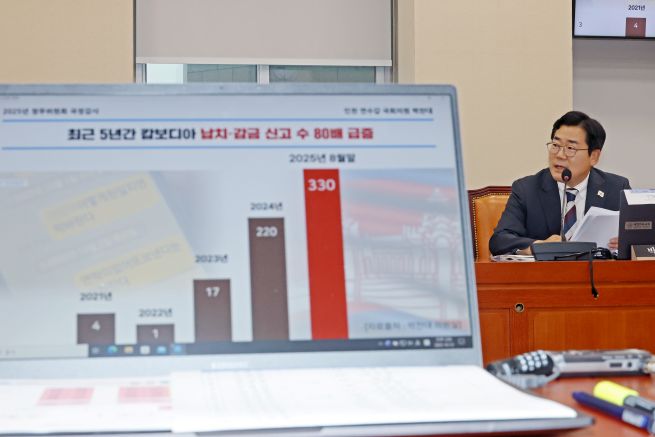
Rep. Park Chan-dae of the Democratic Party questions Yoon Chang-ryul, head of the Prime Minister’s Office, about the recent kidnappings of South Korean nationals in Cambodia during a parliamentary audit by the National Policy Committee at the National Assembly in Seoul on October 13. (Yonhap)
SEOUL, Oct. 14 (Korea Bizwire) — South Korean lawmakers across party lines have condemned the government’s handling of a sharp rise in kidnapping and confinement cases involving Korean nationals in Cambodia, urging swift and decisive measures — including the possibility of military intervention — to protect citizens abroad.
During a National Assembly audit on Sunday, Rep. Park Chan-dae of the ruling Democratic Party cited government data showing that reports of Korean kidnappings in Cambodia have jumped from just four cases in 2021 to 220 in 2024, reaching 330 by August 2025. “The situation has exploded more than a hundredfold,” he said. “What exactly was the Prime Minister’s Office doing while these numbers were surging year after year?”
Rep. Park Beom-gye, also from the Democratic Party, stressed that “a completely new level of response” is needed, calling for a whole-of-government approach. “Cambodia has long been a major beneficiary of Korea’s Official Development Assistance (ODA),” he said. “Given the gravity of this crisis, the government must consider every option — diplomatic, law enforcement, even military if necessary.”
Government data show that South Korea’s ODA to Cambodia more than doubled under the previous Yoon Suk Yeol administration, rising from 178.9 billion won in 2022 to 435.3 billion won in 2024, funding projects such as the Cambodia–Korea Friendship Bridge. Cambodia has since become Seoul’s largest aid recipient, with total annual assistance reaching roughly $195 million.
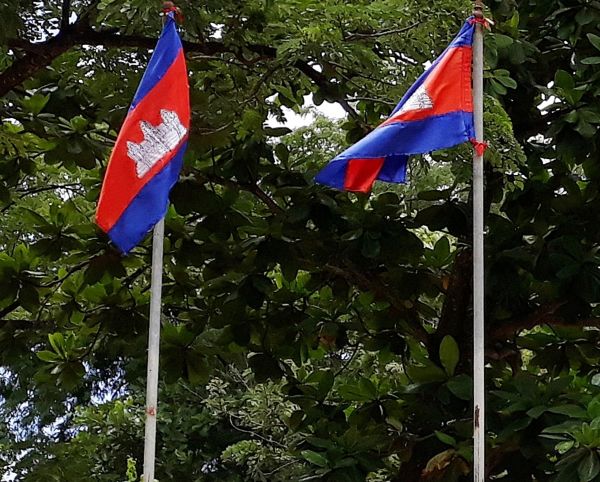
Voices have grown across both ruling and opposition parties calling for an active response to crimes against Koreans in Cambodia “even if it requires military operations.” The photo shows the Cambodian flag. (Photo credit: Yonhap)
Rep. Yoon Hu-duk criticized the government’s apparent lack of urgency. “This is the same country that once dispatched a private jet for a single abducted citizen,” he said. “Now, with hundreds of Koreans detained, we still have no ambassador in place — what is the Foreign Ministry doing?”
Opposition lawmakers from the People Power Party echoed the criticism. Rep. Kang Min-kuk questioned whether the government even knows the full scale of unreported victims, warning that “hundreds of citizens are being held in desperate conditions while the administration remains passive.” He also urged the government to consider suspending or reclaiming ODA funds if Cambodia refuses to cooperate on rescue operations.
In response, Yoon Chang-ryul, head of the Prime Minister’s Office, conceded that the government had been slow to act. “It’s true that we failed to fully grasp the severity of the situation as the cases increased,” he said, adding that the administration now views the matter as “extremely urgent” and will “mobilize all available means” to resolve it.
The escalating crisis underscores the growing tension between citizen protection and diplomatic restraint — testing the government’s ability to balance humanitarian responsibility with strategic foreign relations in one of Asia’s most complex regions.
M. H. Lee (mhlee@koreabizwire.com)