The Era of 7 Million Working Seniors. (Image courtesy of Yonhap)
SEJONG, Oct. 23 (Korea Bizwire) — South Korea’s non-regular workforce has climbed to its highest level on record, surpassing 8.56 million as of August, with older workers driving much of the increase and the wage gap between regular and non-regular employees widening to an all-time high, government data showed Wednesday.
According to the National Data Office’s supplementary survey on employment types, the number of non-regular workers rose by 110,000 from a year earlier, marking the largest tally since the data series began in 2003.
Non-regular employees now account for 38.2 percent of all wage earners — a proportion unchanged from last year but still the second highest on record after 2021.
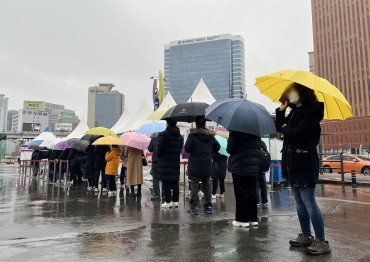
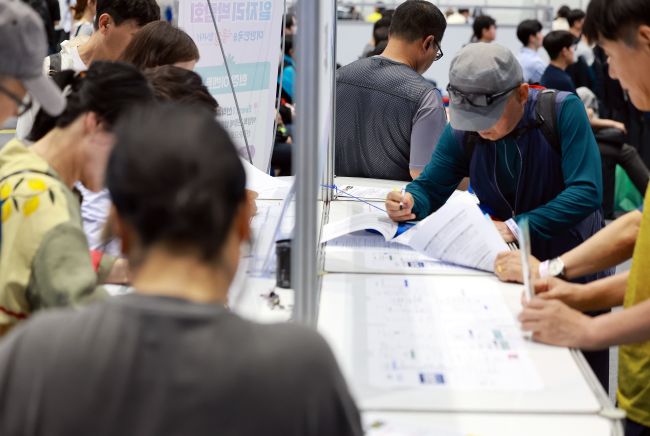
For the first time, the number of temporary and contract-based workers aged 60 and older exceeded 3 million, reflecting both demographic shifts and government-run senior employment programs.
The 60-plus group now makes up more than a third of all non-regular workers, up 2.3 percentage points from last year. Within that, the number of non-regular workers aged 70 and above reached roughly 1.2 million — nearly the same as those in their 40s.
Employment growth was most pronounced in healthcare and social services, where government job programs for seniors are concentrated. By contrast, hospitality, construction, and retail — sectors heavily exposed to domestic demand — all saw declines in non-regular employment.
Women accounted for 57.4 percent of all non-regular workers, the highest share ever recorded.
The wage divide between regular and non-regular employees has also reached a historic peak. Average monthly pay for non-regular workers stood at 2.09 million won, barely half that of regular employees, who earned 3.90 million won on average. The gap of 1.81 million won marks the largest since the government began tracking the data in 2004.
Even when excluding part-time workers, who often work fewer hours, non-regular employees earned 3.04 million won per month — about 78 percent of regular workers’ wages.
While the number of non-regular workers has risen steadily since the pandemic, the nature of such employment is also changing. About two-thirds of non-regular employees now say they chose their work arrangements voluntarily, citing satisfaction with job conditions, flexibility, or the ability to balance work and family life.
Still, the expansion of temporary and elderly employment reflects deeper structural strains in South Korea’s labor market — one increasingly reliant on short-term and low-security jobs to sustain both its aging population and a sluggish post-pandemic economy.
M. H. Lee (mhlee@koreabizwire.com)