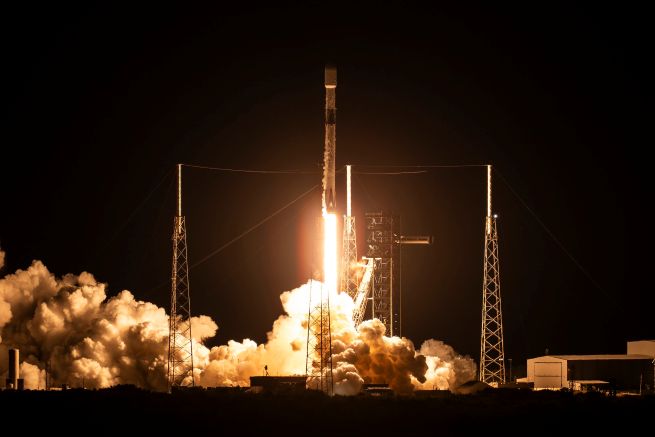
This photo, provided by the defense ministry courtesy of SpaceX, shows a Falcon 9 rocket carrying South Korea’s fifth spy satellite lifting off at Cape Canaveral Space Force Station in Florida on Nov. 2, 2025. (Yonhap)
SEOUL, Nov. 2 (Korea Bizwire) — South Korea said Sunday that its fifth and final homegrown military reconnaissance satellite has successfully entered orbit after launching aboard a SpaceX Falcon 9 rocket from Florida, marking a milestone in the country’s push to build an independent surveillance network capable of monitoring North Korea around the clock.
The Falcon 9 lifted off from Cape Canaveral Space Force Station at 1:09 a.m. local time, placing the synthetic aperture radar satellite into orbit roughly 14 minutes later, according to the Defense Ministry. The satellite established stable communication with a ground control center about an hour after liftoff, confirming normal operations.
The launch completes South Korea’s multi-year project to deploy five military spy satellites by the end of this year, a program designed to reduce reliance on U.S. satellite imagery and strengthen early warning capabilities against North Korean threats. Three of the satellites are fully operational, while the fourth remains under evaluation.
“With this launch, South Korea now possesses the capability to conduct independent, all-weather surveillance and reconnaissance across the entire Korean Peninsula,” the ministry said, adding that once the system is fully integrated, the military will be able to monitor the North every two hours.
Defense Minister Ahn Gyu-back hailed the launch as the completion of the country’s autonomous reconnaissance system, calling it a “critical step toward 24-hour monitoring” and vowing to advance defense-space technologies further.
The satellite, equipped with synthetic aperture radar (SAR) technology, can capture high-resolution images regardless of weather or lighting conditions. The first of the five satellites, launched in December 2023, carried electro-optical and infrared sensors for detailed imaging.
The development comes as North Korea accelerates its own efforts to establish space-based reconnaissance capabilities. Pyongyang successfully launched its first military spy satellite, the Malligyong-1, in November 2023 and pledged to send three more into orbit in 2024, though a subsequent attempt in May ended in failure when its rocket exploded shortly after takeoff.
Kevin Lee (kevinlee@koreabizwire.com)