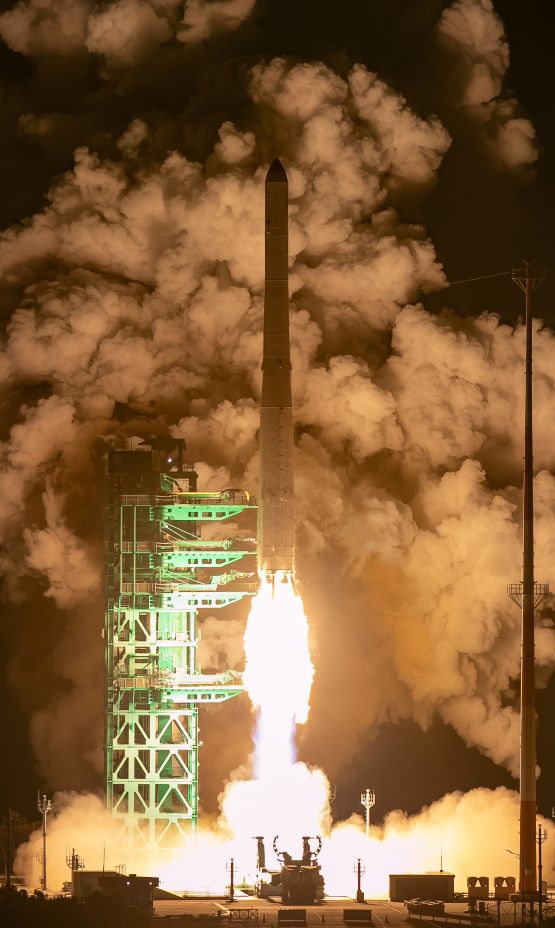
The Nuri space rocket takes off from Naro Space Center in Goheung, 473 kilometers south of Seoul, on Nov. 27, 2025, in this photo released by the Korea Aerospace Research Institute. (Yonhap)
MUAN, Nov. 27 (Korea Bizwire) — South Jeolla Province is celebrating a wave of high-profile successes — from attracting global data centers and fusion research facilities to the successful launch of the Nuri rocket — cementing its ambitions to become South Korea’s “energy capital.”
Early Thursday morning, the country’s first privately built Nuri (KSLV-II) rocket lifted off from the Naro Space Center in Goheung, marking the fourth successful launch of the domestically developed vehicle. The achievement reinforced Goheung’s status as Korea’s gateway to space.
Governor Kim Yung-rok hailed the launch on social media as “a historic milestone that marks the dawn of Korea’s full-fledged private space era,” adding that Goheung is now firmly positioned as the nation’s frontline base for the New Space industry. He said the achievement boosts prospects for securing a second national space center in the region.
The launch caps a year of major gains for South Jeolla in emerging industries. In October, the province secured a dedicated AI data center jointly developed by OpenAI and SK.
The facility, equipped with 10,000 GPUs, will operate alongside SK’s larger Amazon-partnered center in Ulsan. Soon after, a Samsung SDS–led consortium selected the province as the site for the national AI Computing Center — a 2.5 trillion-won mega project — solidifying South Jeolla’s trajectory as a national AI hub.
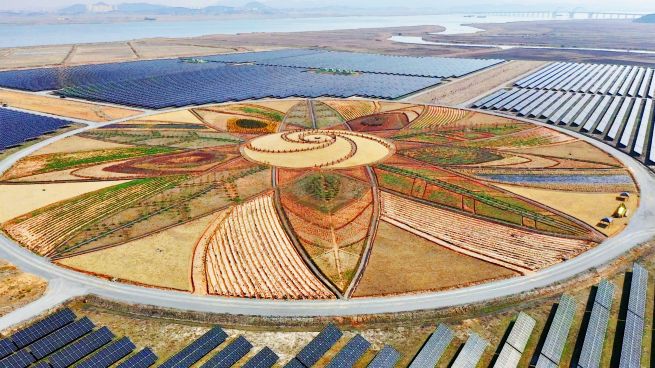
SOLASIDO Corporate City Renewable Energy Industrial Complex (Image provided by Haenam County)
The province also recently won the government bid to host Korea’s flagship nuclear fusion research facility, often dubbed the “artificial sun.” Selected as the top candidate, Naju will house the project, which promises near-limitless clean energy: one gram of hydrogen could yield as much energy as eight tons of oil, with no carbon emissions.
Fusion is less vulnerable to weather conditions than solar or wind power and can draw hydrogen and lithium from seawater, offering an estimated 15 million years of potential supply.
Officials say that these wins are the culmination of the province’s long-term “Blue Economy” strategy, launched in 2019 to build future growth engines based on renewable energy and digital innovation. The momentum is also drawing political attention, given Governor Kim’s growing national profile as he pursues a third term.
“South Jeolla has leveraged its abundant renewable resources and prepared early for national AI and space initiatives,” a provincial official said. “We are finally seeing those efforts translate into real results.”
Ashley Song (ashley@koreabizwire.com)