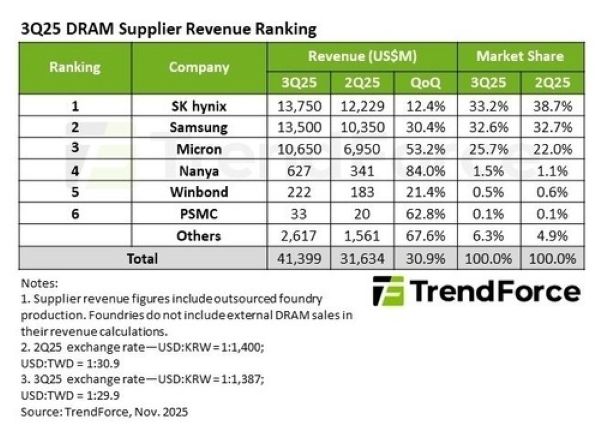
This file photo, provided by TrendForce, shows the DRAM supplier revenue rankings for the third quarter of 2025.(Yonhap)
SEOUL, Dec. 7 (Korea Bizwire) — Samsung Electronics Co. is set to reclaim the top spot in the global market for dynamic random-access memory (DRAM) by revenue in the fourth quarter, overtaking its domestic rival SK hynix Inc., industry sources said Sunday.
The South Korean tech giant is projected to post an operating profit of over 18 trillion won (US$12.2 billion) in the October-December period, beating market expectations, according to the sources.
Samsung’s device solutions division, which oversees the company’s semiconductor business, is expected to account for 15.1 trillion won of the total operating profit, sharply up by 422 percent from a year earlier.
With the earnings surprise, Samsung will likely rank No. 1 in the global DRAM supplier revenue ranking for the fourth quarter, pushing SK hynix to second place.
Samsung, which had maintained its leader position in the DRAM market for 33 years, lost its position to SK hynix in the first quarter as it lagged behind the competition over high bandwidth memory (HBM) chips.
SK hynix was the world’s first company to develop HBM chips, a core component for artificial intelligence (AI) applications, in 2013, and has since been leading the global HBM market.
Industry analysts say Samsung’s recent efforts to narrow the technology gap with its rival in HBM, combined with rising prices for conventional DRAM products driven by investment in artificial intelligence infrastructure, such as data centers, have bolstered its performance.
The average price of 8-gigabit DDR4 for computers increased 15.7 percent on-month to $8.1 in November, according to market research firm DRAMeXchange.
Prices have jumped sixfold since March, when they stood at $1.35, and are expected to rise by as much as 50 percent in the fourth quarter compared with the previous three months.
(Yonhap)