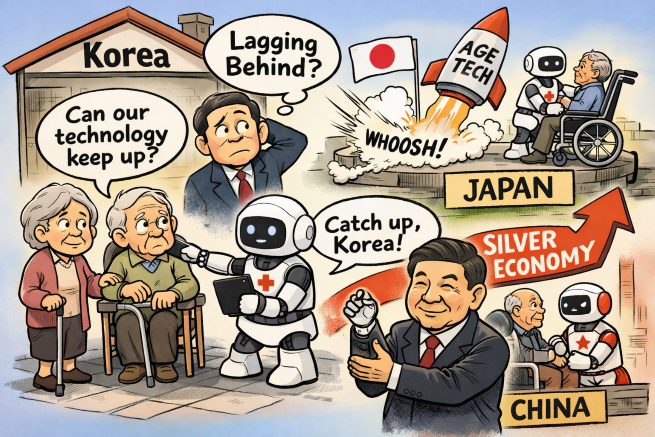
In Aging Societies, Caregiving Becomes a Technology Challenge (Image supported by ChatGPT)
SEOUL, Jan. 8 (Korea Bizwire) — When an elderly man in his 80s fell from his bed in a home in Daejeon last November, it was not a family member or a phone call that brought help, but a caregiving robot.
The device detected the emergency, issued an alert and guided firefighters to the scene, allowing the man to receive hospital treatment. His wife was at home but had a hearing impairment, and his mobile phone was out of reach.
The episode has become a vivid illustration of how artificial intelligence is reshaping daily life in South Korea’s rapidly aging society—and how the so-called “silver economy” is emerging as a new industrial battleground.
Demand for eldercare technologies, including health-monitoring and emotionally interactive robots, is growing quickly as Korea’s population ages. But domestic manufacturers face intensifying competition from lower-priced Chinese imports, raising concerns about whether Korea can build a globally competitive industry of its own.
The issue gained fresh attention this month when President Lee Jae-myung met with Xi Jinping, who called for deeper bilateral cooperation in emerging sectors such as artificial intelligence, green industries and the silver economy.
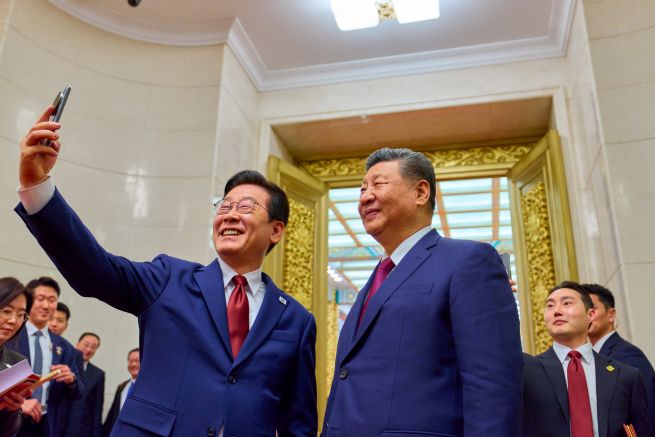
South Korean President Lee Jae Myung (L) takes a selfie with Chinese President Xi Jinping by using a Xiaomi smartphone following a state dinner for the South Korean leader in Beijing on Jan. 5, 2026. The smartphone was gifted to Lee by Xi during their first summit talks in Gyeongju, South Korea, in November 2025. (Pool photo) (Yonhap)
While AI and green technology have long been highlighted as strategic priorities, Xi’s explicit reference to eldercare underscored how seriously China views the sector’s growth potential.
China, which began implementing its 15th five-year plan this year, has identified the expansion of eldercare services and the silver economy as a national objective. Although China’s population is younger than that of Japan or South Korea, people aged 65 and older already accounted for 15.6 percent of its population in 2024, placing it firmly among aging societies.
According to the Korea Trade-Investment Promotion Agency, or KOTRA, China’s silver economy surpassed 12 trillion yuan in 2023 and could reach 30 trillion yuan by 2035—several times the size of South Korea’s annual government budget. Analysts warn that as the sector matures, Chinese firms are likely to expand aggressively overseas.
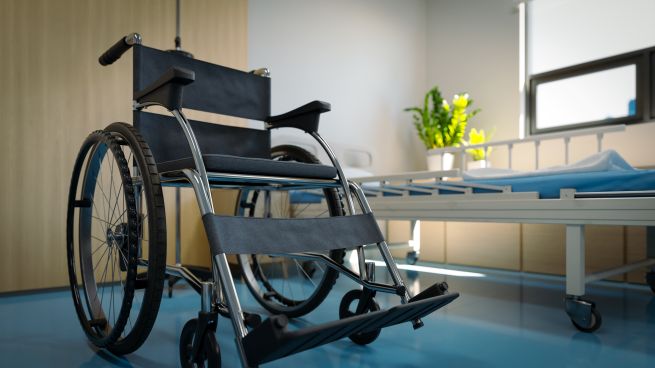
Survey Finds Nearly Half of Korean Disability Caregivers Are Alone in Their Role (Yonhap)
Japan, having entered an aging society earlier, already leads in eldercare technologies. China, a latecomer, is closing the gap rapidly by leveraging advances in AI and robotics. South Korea, by contrast, has yet to treat the silver economy as a core strategic industry, experts say.
The Industrial Research Institute warned in a report last year that delays in developing eldercare robots and smart devices could leave Korea dependent on foreign suppliers, allowing overseas firms to reap the benefits of domestic demand growth.
As major economies pour resources into so-called “age tech,” policymakers and industry leaders in South Korea face a pressing question: whether the country can build a competitive eldercare industry that allows older adults to rely on homegrown technologies—rather than imported ones—for devices that may become as personal as extensions of their own bodies.
Kevin Lee (kevinlee@koreabizwire.com)