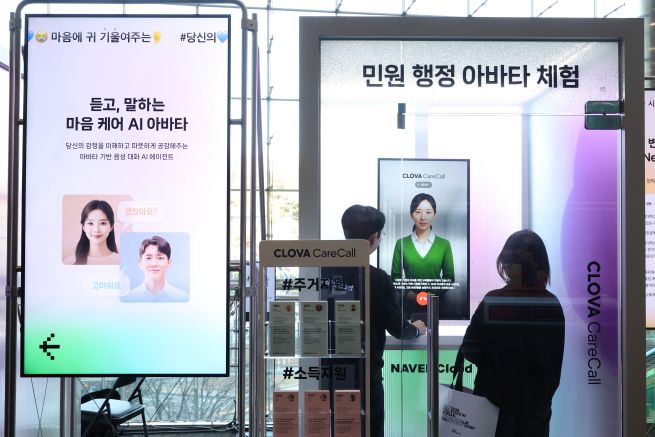
Naver’s cloud booth at the first presentation of the “Sovereign AI Foundation Model” project, held on Dec. 30 at COEX in Gangnam, Seoul. (Yonhap)
SEOUL, Jan. 12 (Korea Bizwire) — South Korea’s ambitious push to develop a homegrown artificial intelligence foundation model has become mired in controversy even before its first round of selections is announced, exposing deep divisions within the country’s AI industry over what truly constitutes technological independence.
The government-led “Sovereign AI Foundation Model” project, launched to reduce reliance on U.S. and Chinese artificial intelligence systems, has sparked heated disputes among participating companies over eligibility criteria, particularly the use of foreign technologies.
While accusations and counterclaims have intensified, the Ministry of Science and ICT has said it will refrain from public comment until the initial selection results are released later this month.
At the heart of the debate is the government’s original definition of a sovereign AI model. According to project guidelines distributed by the ministry, qualifying models must be developed domestically from the design stage through pretraining, rather than derived from fine-tuning overseas models. Crucially, the guidelines also stipulate that such models should be free from foreign licensing constraints.
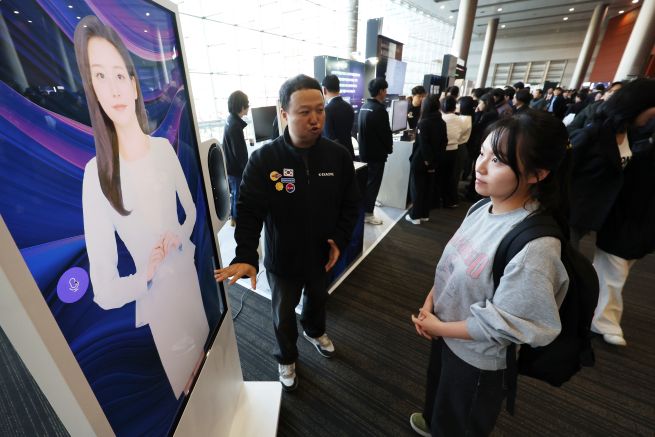
The LG AI Research booth at the first presentation of the “Sovereign AI Foundation Model” project, held on Dec. 30 at COEX in Gangnam, Seoul. (Yonhap)
The emphasis on licensing independence reflects the project’s strategic origins. In the wake of rapid advances by U.S. and Chinese tech giants following the rise of ChatGPT, policymakers grew increasingly concerned about AI sovereignty, warning that dependence on foreign models could expose South Korea to rising licensing costs and national security risks in sensitive sectors such as defense and healthcare.
Those concerns have now resurfaced as rival firms scrutinize one another’s development practices. Upstage and SK Telecom have come under fire for using inference code associated with Chinese AI models, while Naver Cloud has faced criticism for incorporating a vision encoder and weights from Alibaba’s Qwen 2.5 model.
Industry experts note, however, that the nature of these dependencies differs significantly. Inference code, used by Upstage and SK Telecom, is generally distributed under the Apache 2.0 open-source license, which allows commercial use with attribution and is widely regarded as free from licensing interference.
By contrast, critics argue that Naver Cloud’s use of Alibaba’s model components could raise longer-term risks if licensing terms tighten.
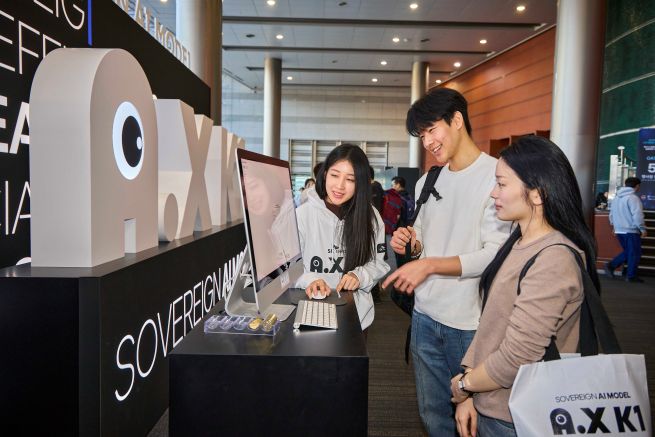
A visitor uses SK Telecom’s A.X K1 model at the first presentation of the Independent AI Foundation Model Project, held on Dec. 30 at COEX in Gangnam, Seoul. (Image provided by SK Telecom)
Alibaba’s licensing framework already imposes stricter conditions on larger versions of its models, including requirements to seek permission if services exceed 100 million monthly active users, with disputes governed exclusively under Chinese law.
While Naver Cloud has said it can replace foreign components with its own technology if necessary, competitors warn that sudden changes to core systems could create inefficiencies if the model is widely deployed as a national AI asset.
The government has said that selected models will be deployed under a “AI for All” strategy, supporting public services and broader industrial digital transformation. Evaluation criteria place equal weight on technical capability, development strategy and plans to expand public access to AI.
The Ministry of Science and ICT is expected to announce the first round of selected consortia around Jan. 15, a decision that could set a lasting precedent for how South Korea defines and safeguards its technological sovereignty in the age of artificial intelligence.
Kevin Lee (kevinlee@koreabizwire.com)