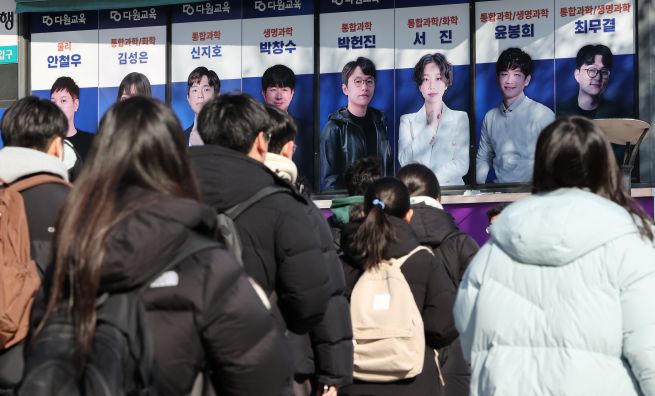
Despite a shrinking school-age population, total private education spending in South Korea has risen by more than 60 percent over the past decade. The increase has been driven in particular by the growing trend toward private tutoring at younger ages, with spending among elementary school students rising far faster than among middle and high school students. The photo shows the private academy district in Daechi-dong, Seoul’s Gangnam district. (Yonhap)
SEOUL, Jan. 14 (Korea Bizwire) — As South Korea braces for sweeping changes to its college admissions system following a particularly difficult 2026 College Scholastic Ability Test, winter break has become the most intense—and expensive—season yet for private education.
Enrollment at winter academies and early preparatory courses for repeat test-takers has surged beyond capacity, with programs costing 2 million to 3 million won ($1,500–$2,200) for just six to seven weeks selling out rapidly. Many parents say they are unable even to secure spots on waiting lists, despite mounting concerns over costs.
The rush reflects growing anxiety among students and families after the latest exam, widely dubbed a “brutal CSAT,” and ahead of the final year of the current grading and integrated testing systems.
According to Lim Sung-ho, head of Jongro Academy, early enrollment in comprehensive programs for repeat examinees is up 10 to 20 percent from a year earlier, driven by both high-achieving students who narrowly missed their targets and lower-performing students seeking structure and motivation.
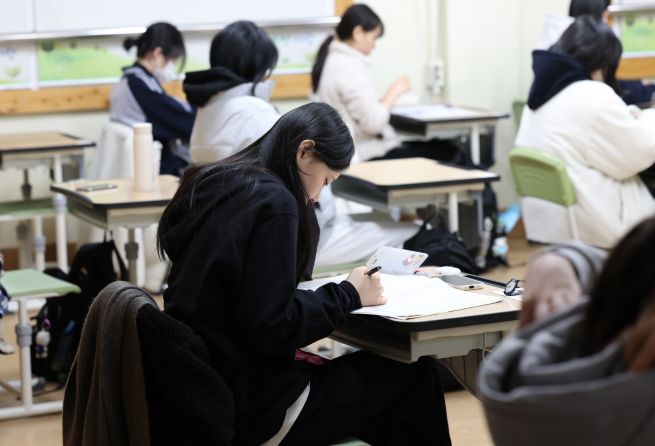
Students wait and study before the exam begins at Gyeongshin Girls’ High School in Buk-gu, Gwangju, on Nov. 16, the day of the College Scholastic Ability Test (CSAT). (Photo provided by Yonhap)
Private institutes have capitalized on the anxiety by aggressively promoting winter “special lectures,” often framing them as essential rather than optional. In some cases, academies require students to enroll in additional classes to keep pace with regular coursework, pushing monthly tuition for a single subject well beyond 1 million won.
The financial burden comes as private education spending continues to climb nationwide. Government data show that total private education spending reached 29.2 trillion won in 2024, up more than 60 percent from a decade earlier. The strain is particularly acute during school breaks, when special programs proliferate.
Online parent forums have filled with posts expressing discomfort and resignation. Many parents say they feel compelled to enroll their children out of fear they will fall behind peers, even if they question the educational value. Others note that transferring between academies is difficult because curricula and progress levels vary widely.
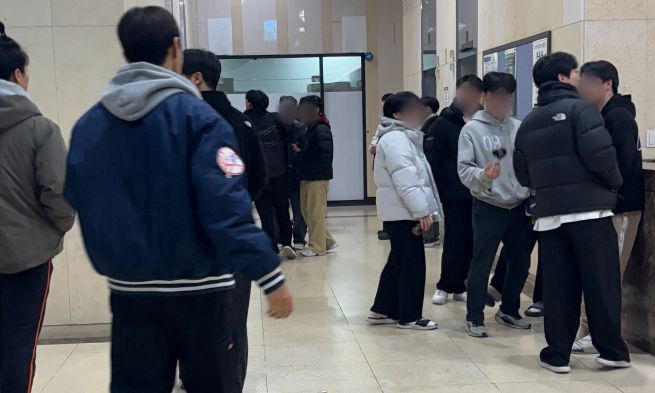
Students are seen talking inside a comprehensive private academy building in Mok-dong, Yangcheon District, another area widely regarded—alongside Daechi-dong—as one of Seoul’s major hubs for private education. (Yonhap)
Education experts warn that the cycle is self-reinforcing. “These programs are technically optional, but socially they don’t feel that way,” said Han Moon-seop, an emeritus professor of English education at Hanyang University. “Parents’ anxiety feeds demand, which in turn drives up costs and reinforces dependence on private education.”
While some winter programs offer small-group, customized instruction that public schools cannot easily replicate, experts caution that academic gains ultimately depend less on additional classes than on students’ independent study habits—an increasingly difficult message to deliver amid intensifying competition and uncertainty.
Lina Jang (linajang@koreabizwire.com)