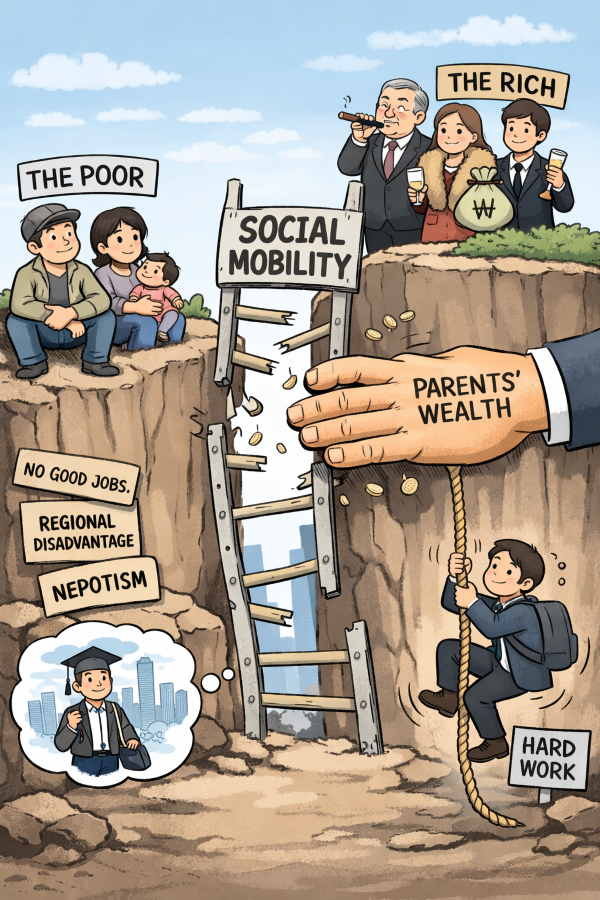
Faith in Hard Work Persists, but Belief in Class Mobility Wanes (Image supported by ChatGPT)
SEOUL, Feb. 9 (Korea Bizwire) — Only one in four South Korean adults believes that social mobility in the country is active, underscoring deepening skepticism about whether the promise of upward movement still holds.
The findings, released Sunday by the Korea Institute for Health and Social Affairs, are based on a nationwide survey of 3,000 adults conducted between May 18 and June 20 last year. The study examined public perceptions of social mobility — the ability of individuals or groups to move between socioeconomic strata.
Just 25.4 percent of respondents said social mobility in South Korea is “active,” while 59.2 percent described it as “average” and 15.4 percent said it is “not active.” Taken together, the results suggest that a clear majority of adults do not view upward mobility as functioning smoothly.
Asked why mobility appears limited, 43.4 percent cited the influence of parents’ wealth and social background on children’s success as the primary reason. Researchers noted that rising wealth inheritance and widening asset inequality in recent years may have reinforced the perception that opportunity is unevenly distributed.
Other frequently cited factors included the divide between desirable and undesirable jobs in the labor market (17.3 percent), the influence of one’s region of origin or residence (13.6 percent), and the role of social connections (10.6 percent).
Yet the survey also revealed a measure of resilience in public attitudes. When asked whether individual effort could raise one’s socioeconomic status, 42.5 percent said the likelihood was high and 50.7 percent described it as moderate. Only 6.8 percent viewed the possibility as low.

Perception Gap: Limited Social Mobility, Enduring Faith in Effort (Image courtesy of Yonhap)
The findings point to a nuanced outlook: while many Koreans doubt that the broader system guarantees mobility, a significant share still believes that hard work can make a difference.
Even so, perceptions of structural influence remain strong. Sixty-eight percent of respondents said parental socioeconomic support affects children’s future status, while just 0.7 percent believed it has no impact.
The results highlight a tension at the heart of South Korea’s social narrative — between lingering faith in personal effort and growing concern that the ladder of opportunity is increasingly shaped by family background.
Lina Jang (linajang@koreabizwire.com)