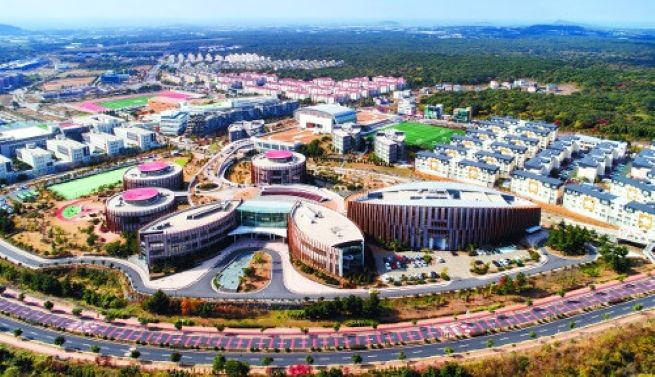
A view of Branksome Hall Asia (BHA), a leading international school in Jeju English Education City. (Photo provided by the Jeju Free International City Development Center)
JEJU, Feb. 12 (Korea Bizwire) — Enrollment at the international schools in Jeju’s English Education City has declined for a second consecutive year, raising concerns about the future competitiveness of a project once envisioned as a domestic alternative to overseas study.
According to the Jeju provincial government, the combined student population at four international schools fell from 4,868 in 2023 to 4,638 in 2024 and further to 4,133 in 2025. The pace of decline has accelerated, with enrollment dropping 4.7 percent in 2024 and 10.9 percent in 2025. Capacity utilization has also slipped, from 84.5 percent to 71.7 percent over the same period.
The downturn prompted Governor Oh Young-hoon to convene a meeting this week with the heads of the four schools — Korea International School Jeju, North London Collegiate School Jeju, Branksome Hall Asia and St. Johnsbury Academy Jeju — along with representatives of their operating foundations.
School leaders cited growing competition from more than 200 unaccredited international schools nationwide, calling for stronger regulatory oversight. They also urged joint marketing efforts and improvements to local living conditions, including expanded medical infrastructure, the introduction of direct flights between Jeju and Incheon, and adjustments to language requirements for dual-nationality students.
Governor Oh described the English Education City as a national initiative launched under the Roh Moo-hyun administration to curb capital outflows from overseas study and bolster domestic educational competitiveness while promoting balanced regional development. Strengthening the international schools, he said, is essential not just for individual institutions but for the sustainability of the entire education hub.
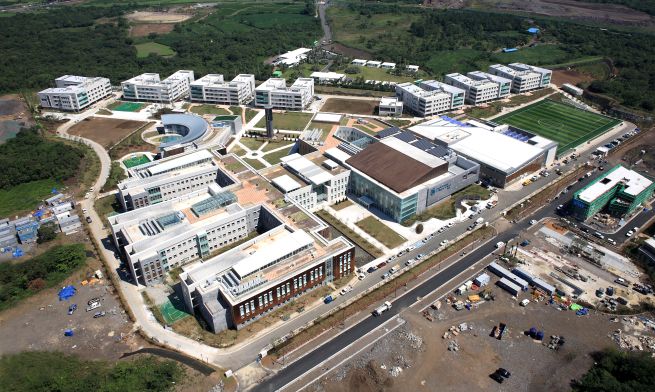
International schools in Jeju English Education City (Yonhap)
The provincial government pledged to coordinate with the Education Ministry on the issue of unaccredited schools and to promote the education city through overseas marketing events. It also said it would review proposals related to transportation links, health care expansion and regulatory reforms.
Established in 2006 in Seogwipo, the Jeju English Education City spans nearly 3.8 million square meters and was designed as a global education cluster. The four international schools have operated there since 2011, 2012 and 2017, drawing students from across South Korea and abroad.
But as competition intensifies and domestic demographics shift, the enclave faces a new test: sustaining its appeal in a rapidly changing education market.