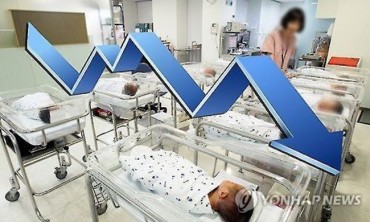
Equal Pay, Unequal Paths: South Korea’s Push to Level the Wage Field (Image courtesy of Yonhap)
South Korea Moves to Codify ‘Equal Pay for Equal Work’ by 2025, Amid Hurdles to Implementation
SEOUL, Aug. 17 (Korea Bizwire) — The South Korean government is set to codify the principle of “equal pay for equal work” into the Labor Standards Act by the end of this year, aiming to implement the policy as early as the second half of 2026. The move, part of the Yoon administration’s five-year national governance plan, seeks to eliminate wage discrimination based on employment type or gender across workplaces nationwide.
Push for Legal Mandate
Currently, the equal pay principle is addressed only in the Gender Equality Employment Act and is limited in scope to preventing gender-based discrimination. The proposed revision would add provisions to the Labor Standards Act requiring employers to pay the same wages for work of equal value — regardless of whether the employee is regular or non-regular staff.
This legislative move echoes a longstanding campaign promise by President Lee Jae-myung, who has consistently criticized the inequity in wages between regular and irregular workers. “It’s irrational that workers doing the same job receive different pay simply due to contract status,” Lee stated during a 2023 parliamentary debate.
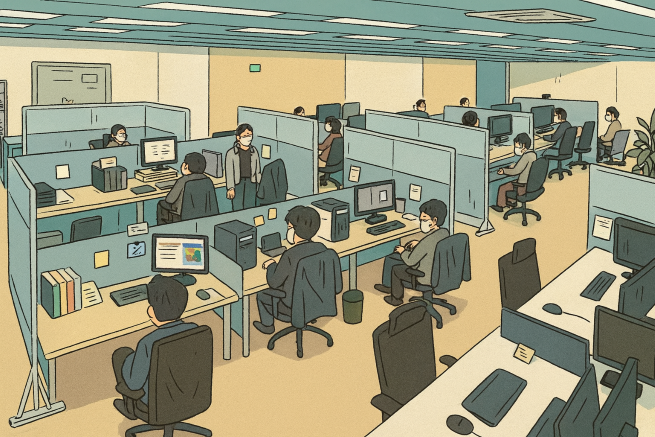
Equal Pay Set to Become Law in Korea as Government Targets 2026 Implementation (Image supported by ChatGPT)
Wage Gap Remains Stark
 According to Statistics Korea, as of August 2024, the average monthly wage for regular employees stood at 3.8 million won, while non-regular workers earned just 2.05 million won — a 46% pay gap. The wage disparity has widened since 2019, when the gap was 1.44 million won.
Despite past administrations’ verbal commitments, this is the first time the government is moving to enshrine the principle in core labor legislation.
Implementation Challenges: Seniority Pay vs. Job-Based Pay
Experts warn that real-world implementation could prove difficult. South Korea’s entrenched seniority-based pay system (yeongongje), where wages increase with tenure rather than job role or performance, contradicts the equal pay principle.
To bridge this gap, the government is promoting a shift to a “job-based pay system,” or jikmugupje, where wages are set according to job duties, responsibilities, and complexity. Labor Minister Kim Young-hoon recently stated that without adopting such a structure, achieving equal pay would be “unrealistic.”
The government plans to use a new “wage distribution system” based on national statistical data to provide employers with transparent benchmarks for setting pay levels by job type, position, and tenure.
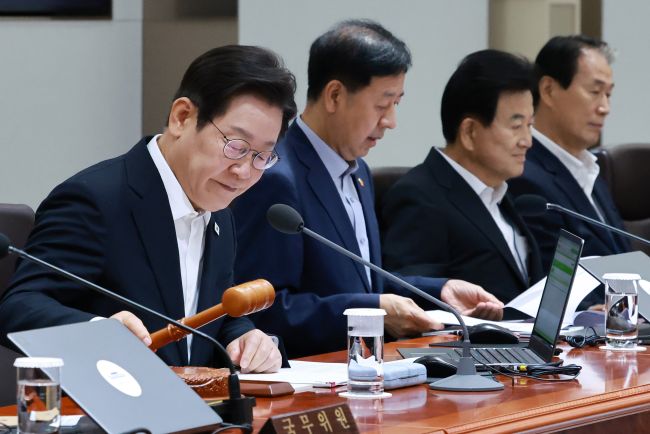
President Lee Jae Myung (L) bangs the gavel during an extraordinary Cabinet meeting held at the presidential office in Seoul on Aug. 11, 2025, to review a list of special pardons. (Image courtesy of Yonhap)
Corporate Resistance and Union Limitations
Business groups have expressed concern, warning that uniform wages may overlook performance differences among employees. Some regular workers have also voiced fears of “reverse discrimination.”
South Korea’s enterprise-based union structure is another barrier. Unlike industry-wide unions in Europe that enable uniform wage-setting across similar job types, Korea’s fragmented union system makes it difficult to negotiate wages collectively across companies in the same sector. The government is thus exploring “inter-company collective bargaining” as a workaround.
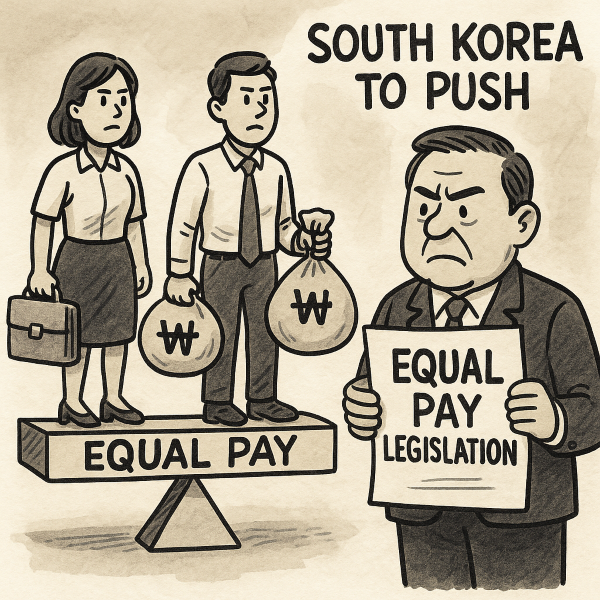
For Korea’s Irregular Workers, A Long-Awaited Step Toward Fairness (Image supported by ChatGPT)
Experts Caution Against Rushed Rollout
Labor scholars agree on the need for legal clarity but say the 2026 timeline may be overly ambitious. “Writing the principle into law won’t change reality overnight,” said Jung Heung-joon, a professor at SeoulTech. “We need to first establish groundwork like job-based wage systems and inter-company bargaining mechanisms.”
Kim Sung-hee of Korea University echoed the need for consensus: “Labor and management still fundamentally disagree on what ‘equal work’ means. We must develop a shared societal model for how to close the wage gap.”
As the government accelerates efforts to legislate equal pay, the success of the initiative may depend less on legal texts and more on how swiftly — and equitably — Korea can reengineer its wage structure and industrial relations framework.
M. H. Lee (mhlee@koreabizwire.com)