The Story Behind Korea’s Laws: Your Guide to Korea’s Legal Pulse
GWANGJU, Oct. 29 (Korea Bizwire) — A South Korean appeals court has acquitted a father and daughter who spent roughly 15 years behind bars for a notorious 2009 poisoning, concluding that the convictions rested on coerced, legally flawed confessions.
The ruling lands in October 2025, under a new political landscape that has made criminal-justice safeguards a renewed point of debate.
The Gwangju High Court vacated prior sentences of life and 20 years for the two defendants, identified only as A, 75, and his 41-year-old daughter, and entered not-guilty verdicts.
Judges found that prosecutors extracted statements from an illiterate father and a daughter with borderline intellectual functioning during lengthy interrogations that failed to honor basic rights, including the presence of counsel, the right to remain silent, and proper record review.
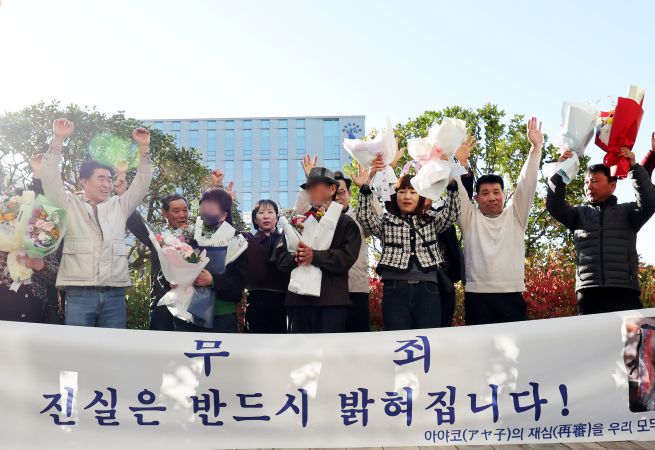
On the afternoon of October 28, in front of the Gwangju High Court in Dong-gu, Gwangju, defendants in the cyanide-makgeolli case cheer during a press conference after being acquitted in a retrial 16 years after the incident.
With no eyewitnesses and a thin evidentiary record, the original case had hinged on staged confessions: the daughter’s first admission, a later account alleging conspiracy with her father, and a separate statement portraying an illicit motive within the family.
The retrial court excluded these as products of leading questions and pressure, citing Korea’s post-2007 criminal-procedure standards that require interrogation records to be lawfully obtained to carry evidentiary weight.
The court also punctured the investigative narrative. Testimony that police “intelligence” had first put the pair in the frame unraveled when a retired officer denied providing any tip.
Scientific inconsistencies—between reenacted cyanide doses and later analytical estimates—further weakened the prosecution’s theory of how the rice wine was poisoned.
The pair’s legal odyssey mirrors systemic fault lines. They were acquitted at trial in 2010, convicted on appeal in 2011, and affirmed by the Supreme Court in 2012.
A 2022 bid for retrial—pressed by a defense lawyer known for wrongful-conviction work—led the Supreme Court last year to reopen the case, steering it back to the appellate bench that has now cleared them.
The acquittals will likely draw scrutiny to interrogation practices and the treatment of vulnerable suspects, even as prosecutors said they will review the decision and consider further appeal.
For the exonerated, the ruling arrives late; for the system, it is a stark reminder that confession-centric prosecutions are only as reliable as the rules that govern them.
Jerry M. Kim (jerry_kim@koreabizwire.com)