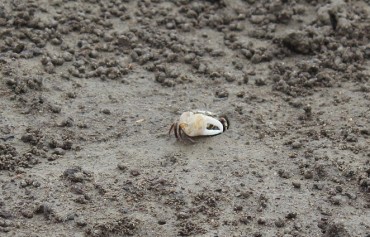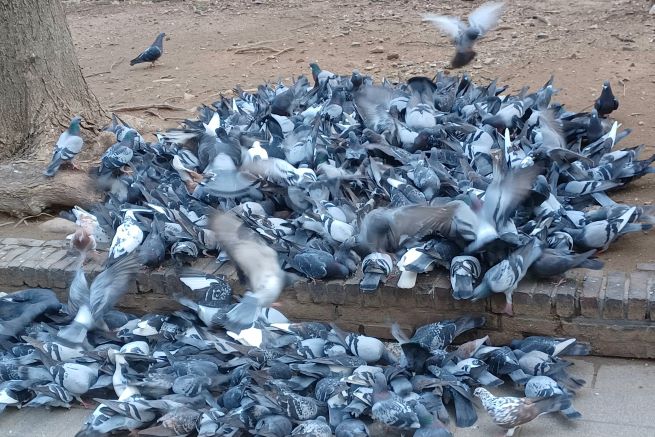
“Harmful wildlife” is defined as species that cause damage to crops or areas due to overpopulation, including pigeons, sparrows, magpies, and larger animals like deer and wild boars. (Yonhap)
SEOUL, Dec. 23 (Korea Bizwire) — Animal rights organizations in South Korea have filed a constitutional complaint against a revised wildlife law that allows local governments to ban the feeding of pigeons, arguing that the measure amounts to state-sanctioned animal cruelty.
At a news conference on Monday outside the Constitutional Court in Seoul, activists from CARE, the Korea Animal Protection Coalition and a civic group advocating for the protection of pigeons said the law violates constitutional principles, including the right to life, the pursuit of happiness and the prohibition of excessive regulation.
The revised Wildlife Protection Act, which took effect on January 24, authorizes municipal and provincial governments to prohibit the feeding of so-called harmful wildlife through local ordinances. Pigeons are included in the category if they are deemed to cause property damage or public inconvenience because of overpopulation, droppings or feather debris.
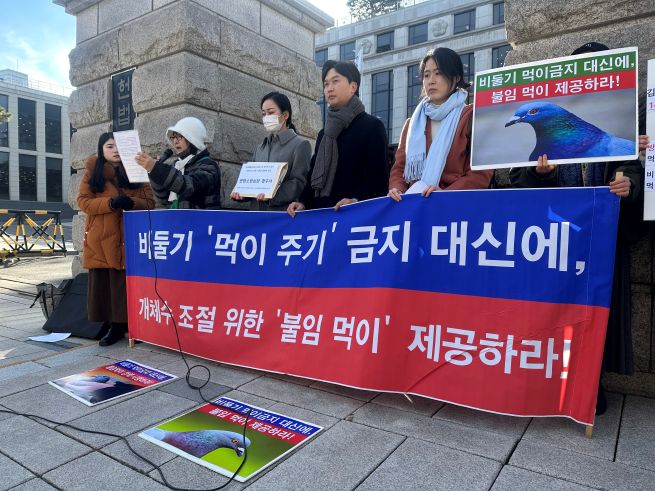
Animal rights groups, including CARE and the Korea Animal Protection Coalition, are holding a news conference on December 22 in front of the Constitutional Court in Jongno District, Seoul. The groups filed a constitutional complaint, arguing that the Wildlife Protection Act, which allows bans on feeding pigeons, is unconstitutional. (Yonhap)
Critics say the policy effectively seeks to reduce pigeon populations through starvation rather than humane control. They called on the government to adopt contraceptive feed programs instead and to abolish the designation of pigeons as harmful wildlife. The groups cited overseas cases, noting that pigeon populations fell by about 55 percent in parts of Spain and roughly 50 percent in St. Paul, Minnesota, after contraceptive feed was introduced.
Seoul has already implemented its own ordinance in line with the revised law. Since January, individuals caught feeding pigeons, magpies or other designated wildlife in the capital can face fines of up to one million won, or about $760.
The constitutional challenge adds to a growing debate in South Korea over how to balance urban management, public health concerns and animal welfare, as cities grapple with wildlife populations in increasingly dense environments.
Lina Jang (linajang@koreabizwire.com)