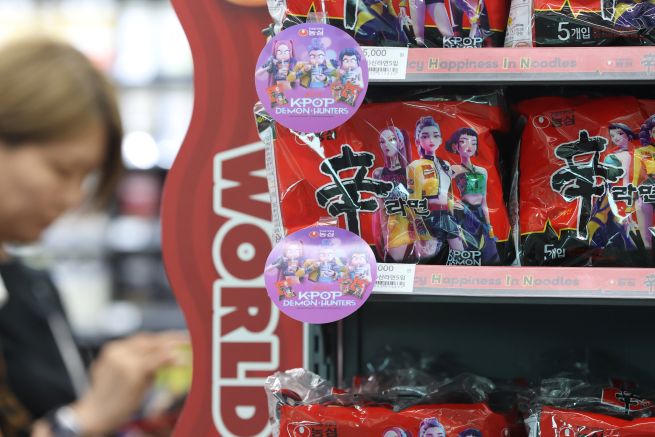
“K-Pop Demon Hunters” products, a collaboration between Nongshim and Netflix, are displayed at a GS25 convenience store. (Yonhap)
SEOUL, Feb. 9 (Korea Bizwire) — In South Korea’s retail and beauty markets, character collaborations have become a near-default marketing strategy. From convenience stores to cosmetics counters, brands have leaned heavily on popular intellectual property to ignite short-term buzz and drive sales.
But after years of explosive growth, signs are emerging that the strategy may be losing steam — and, critics say, eroding brand identity in the process.
“It feels like if they can’t compete on brand value or ingredients, they try to boost attention through collaborations first,” said a consumer who runs a cosmetics-focused social media account with more than 12,000 followers. She noted a noticeable uptick in tie-ins between beauty brands and animated characters, adding that such projects often feel disconnected from the brand’s original concept.
Character intellectual property has become a reliable formula in retail. At convenience store chain CU, the number of collaborative products rose from about 50 in 2021 to roughly 370 last year — a sevenfold increase in four years. Sales surged as much as 320 percent in 2023. Rival GS25 also posted triple-digit growth in collaboration-related revenue that year.
Yet growth has slowed since. CU’s sales gains eased to 82.2 percent in 2024 and 105 percent in 2025, while GS25 recorded increases of 59.8 percent and 53.5 percent over the same period — still robust, but well below the 2023 peak.
Industry officials say the appeal is clear: partnerships with trending characters or celebrities deliver immediate consumer response, fueling fierce competition among retailers to secure the next viral hit.
But critics argue that the strategy prioritizes short-term spikes over long-term brand building. The experience of the craft beer boom offers a cautionary tale. Between 2020 and 2022, a wave of character-themed craft beers flooded shelves after early successes such as “GomPyo Wheat Beer” sold out rapidly.
Many subsequent launches, however, focused more on eye-catching packaging than product differentiation. Consumers quickly lost interest, and numerous products were discontinued.
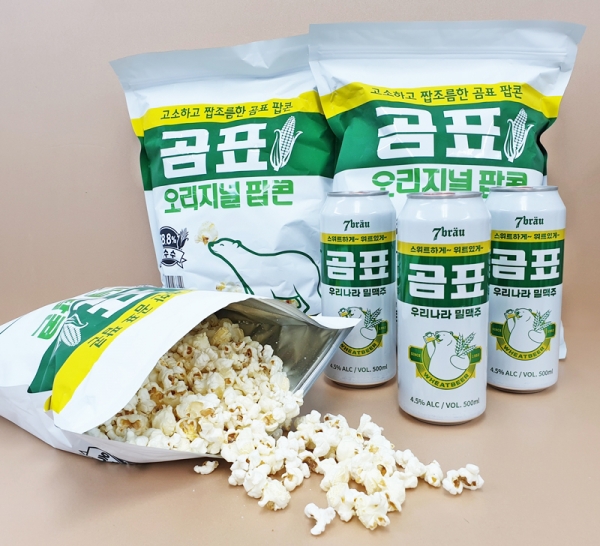
GomPyo Wheat Beer is the industry’s first collaborative craft beer, jointly developed by convenience store chain CU, flour manufacturer and brand Daehan Flour Mills, and brewer Sevenbrau. (Image courtesy of CU)
Observers say the result diluted both the “premium” image of craft beer and the intrinsic strengths of the brands involved.
As the collaboration trend stretches into its fifth year, some consumers complain that distinctive brand identities are fading. The cosmetics influencer said a once-unique “princess concept” beauty brand lost its signature appeal after repeated short-term tie-ins with unrelated characters.
In response, some companies are investing in proprietary characters to reinforce their own identity rather than borrowing external fandoms. Lotte Home Shopping’s Bellygom, CU’s CU Friends and GS25’s Mumu are examples. Bellygom, introduced six years ago, has generated cumulative sales of about 20 billion won, demonstrating the potential of in-house intellectual property.
Still, marketing experts warn of mounting consumer fatigue.
“As the market becomes saturated and it grows harder to capture attention, companies turn to characters that already have established fan bases,” said Lee Eun-hee, a professor of consumer studies at Inha University. “But when collaborations become excessive, consumers inevitably grow tired.”
If shoppers are beginning to see such tie-ins as formulaic, she added, retailers may need to rethink their approach — and rediscover how to build brands that stand on their own.
Ashley Song (ashley@koreabizwire.com)