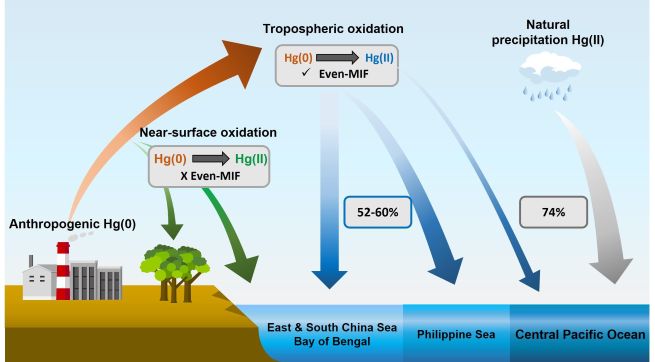
The image provided by POSTECH (Pohang University of Science and Technology)
POHANG, Nov. 26 (Korea Bizwire) — Mercury released from industrial activities in Asia is traveling across the atmosphere and accumulating in marine organisms throughout the Pacific, including tuna, a staple fish consumed worldwide, according to new research led by South Korean scientists.
POSTECH (Pohang University of Science and Technology) said Wednesday that its environmental engineering team, working with researchers from the Korea Institute of Ocean Science and Technology (KIOST) and the Woods Hole Oceanographic Institution (WHOI), has traced mercury found in Pacific fish back to emission sources in Asia.
The study mapped how airborne mercury travels long distances and eventually settles into ocean ecosystems.
Mercury, typically emitted through coal combustion and waste incineration, disperses globally through the atmosphere. Once it enters the ocean, it transforms into methylmercury, a potent neurotoxin that accumulates up the food chain and concentrates in large predatory fish such as tuna.
Although the dangers of mercury contamination have been known since the Minamata disease disaster in Japan in the 1950s, the extent to which Asian emissions contribute to mercury levels in Pacific marine life had not been clearly established, even after the Minamata Convention on Mercury took effect in 2017.
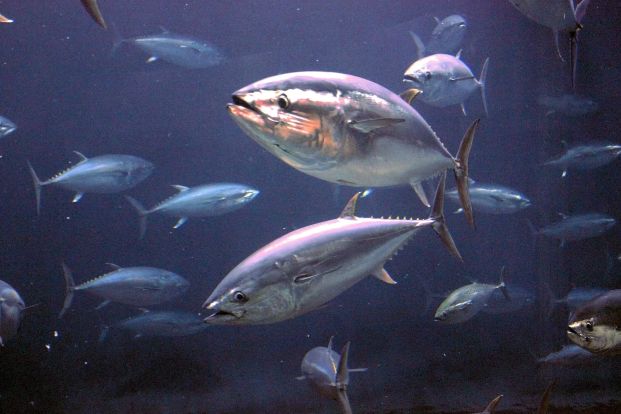
Pacific bluefin tuna (Image courtesy of Animalia.bio/CCL)
The research team collected plankton samples across the western and central Pacific—spanning waters from the Korea Strait to the Bay of Bengal, and from the Philippine Sea to offshore Hawaii—using KIOST research vessels.
By analyzing mercury isotope signatures, which retain unique “fingerprints” tied to their emission sources, scientists were able to track the origin of the mercury found in marine plankton.
Their analysis showed that mercury emitted in Asia is indeed flowing into the Pacific and accumulating in biological systems. The team also found, for the first time, that in coastal waters at least 60 percent of mercury entering the ocean comes from atmospheric deposition rather than from rivers.
The findings were published in Communications Earth & Environment, a Nature Portfolio journal, and featured by DeeperBlue, a leading global ocean science outlet. Researchers say the results offer scientific support for international efforts to curb atmospheric mercury emissions—one of the central aims of the Minamata Convention.
“This study provides quantitative evidence on mercury sources that can guide global public health policymaking,” said POSTECH professor Kwon Seyoon.
Kevin Lee (kevinlee@koreabizwire.com)