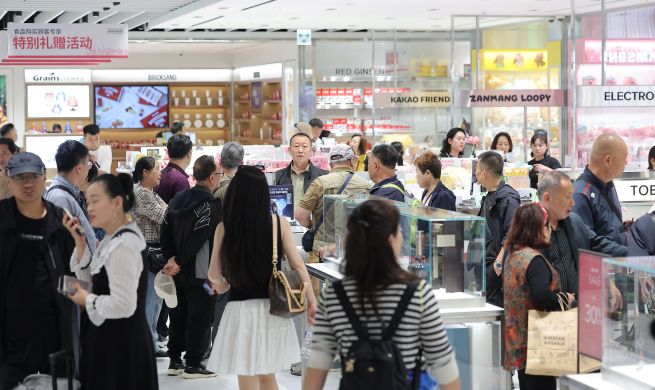
On September 30, at Shinsegae Duty Free’s Myeong-dong branch in central Seoul, Chinese and other tourists browse the store as major retailers prepare events and products tailored to tourist demand under the visa-free entry policy for Chinese tour groups. (Yonhap)
SEOUL, Oct. 2 (Korea Bizwire) — South Korea risks falling short on hotel capacity as the number of foreign visitors is set to surpass 20 million this year, a national audit has found.
The Board of Audit and Inspection said Wednesday that the Ministry of Culture, Sports and Tourism had failed to establish clear standards for analyzing supply and demand of accommodations in regional tourism plans.
In several cases, local governments produced flawed or incomplete forecasts, which the ministry approved without verification.
Seoul, for example, miscalculated future hotel demand by applying business growth rates instead of room counts, leading to a projection that contradicted the ministry’s own findings.
When recalculated with proper data, auditors concluded the capital could face a shortage of tourist rooms by 2026 — a problem that may arrive sooner given the stronger-than-expected rebound in arrivals this year.
The audit also flagged other oversight gaps. Ten golf courses receiving tax breaks under a government program were found to have charged fees above regulated levels, yet the law lacked provisions for penalties. Separately, an official at the Korea National University of Arts was caught embezzling more than 110 million won ($80,000) in operating funds.
Authorities were urged to tighten rules on facility oversight, establish enforcement mechanisms for fee violations and ensure that state loans to shuttered businesses, such as hostels, are recovered.
The findings underscore concerns that South Korea’s booming tourism industry could be undermined by inadequate infrastructure and weak regulatory enforcement at a time when the government is promoting itself as a premier global destination.
Lina Jang (linajang@koreabizwire.com)