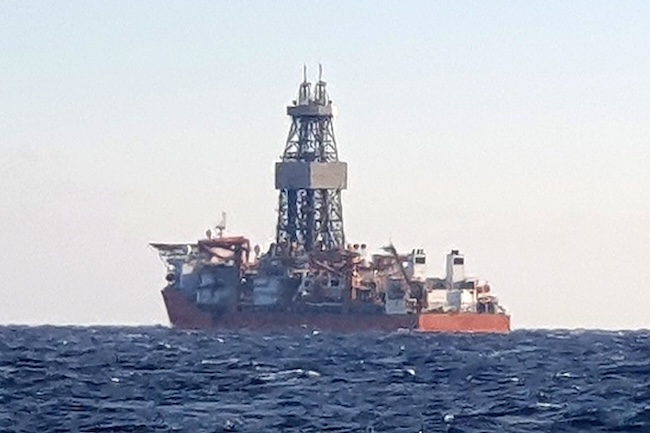
The West Capella, operated by Norway-based Seadrill Ltd., anchors about 40 kilometers off the eastern port city of Pohang on Dec. 18, 2024, for its first drilling operation as part of South Korea’s gas and oil exploration project in the East Sea, dubbed the “Blue Whale Project.” The project is estimated to have the potential to uncover between 3.5 billion and 14 billion barrels of gas and oil. (Image courtesy of Yonhap)
SEJONG, Oct. 26 (Korea Bizwire) — A major offshore gas development project in the East Sea has been thrown into uncertainty as the South Korean government moves to reassess plans that the state-run Korea National Oil Corporation (KNOC) had been pursuing with British oil giant BP.
Industry officials said Sunday that the Ministry of Trade, Industry and Energy is reviewing “whether the project should proceed at all,” signaling that the BP-led partnership — selected internally by KNOC as the preferred bidder earlier this month — may not go forward.
The ministry’s comments came after Trade Minister Kim Jung-kwan publicly distanced the government from the selection, telling lawmakers last week that no foreign company had been formally named. He criticized KNOC for allowing news of the internal decision to leak through the press, saying it had undermined government oversight.
KNOC has been seeking to revive the deep-sea development after early drilling at the field — dubbed “the Great Whale” prospect — failed to confirm commercial reserves. The company launched an international tender to attract investment and technical expertise, offering up to a 49 percent stake to major oil companies, including BP and ExxonMobil.
Officials had hoped that BP’s interest would restore momentum to the project, which is seen as strategically important amid heightened resource competition with China and Japan in surrounding waters.
But the government has recently hardened its position. Lawmakers from the governing party have called for a full re-evaluation of the initiative, citing past controversies over contractor selection. The ministry has already requested a Board of Audit and Inspection review of KNOC’s decision-making.
Some within the energy sector warn that political intervention could deter foreign partners.
“Even if the deal is not canceled outright, a prolonged delay could drive investors away,” said an industry official, noting the reputational risks for South Korean public enterprises undertaking overseas projects.
Analysts say the government could effectively shelve the plan by pausing investment approvals until the audit is complete, potentially leaving the future of the country’s only deep offshore gas ambitions in limbo.
M. H. Lee (mhlee@koreabizwire.com)