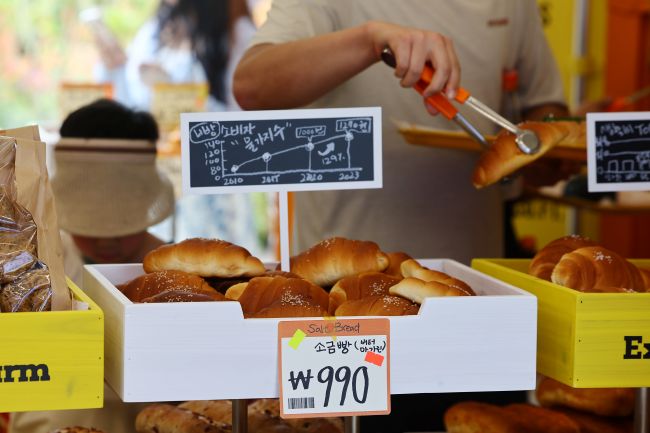
Salt bread is displayed at the ETF Bakery pop-up store by economic YouTuber Shuka, held at Glow Seongsu in Seongdong-gu, Seoul. (Image courtesy of Yonahp)
SEOUL, Sept. 13 (Korea Bizwire) — When a popular YouTube commentator recently began selling a “990 won salt bread,” it was more than a marketing stunt. It was a pointed jab at what Koreans have come to call “breadflation,” a steep rise in bread prices that many believe has made the staple disproportionately expensive at home compared with abroad.
Official data support part of that perception. Since 2020, South Korea’s bread consumer price index has climbed faster than overall food prices, outpacing similar measures in the United States, France and Japan.
Between March and August this year, bread prices rose more than 6 percent annually for six straight months — well above the country’s overall inflation rate of 1 to 2 percent.
A 2023 analysis by Kongju National University found Korea’s bread price index had reached 129, higher than the United States (125), Japan (120) and France (118). By contrast, in the early 2000s, Korean bread prices were among the lowest in the developed world.
The sharp rise is tied to structural factors. Korea imports nearly all of its wheat and other baking staples, leaving bakeries vulnerable to swings in global commodity prices.
Yet consumer advocates argue that prices remain sticky even when input costs fall. “When grain prices stabilize, bread prices don’t come down,” said Lee Eun-hee, a consumer studies professor at Inha University.

Trends in bread-related Consumer Price Index (CPI) . (Image courtesy of Korea Fair Trade Commission)
International surveys have fueled claims that South Korea has the world’s most expensive bread. The Economist Intelligence Unit once reported that Seoul’s bread prices were the highest globally in 2018 and 2019.
The crowdsourced database Numbeo currently ranks Korea 11th worldwide and the most expensive in Asia. But experts caution those rankings rely on limited or inconsistent data and may exaggerate the gap.
Analysts note that Korea’s higher bread prices also reflect its consumption patterns. Unlike in Western countries where bread is a dietary staple, Korea’s market is skewed toward premium and dessert breads, elevating the average cost.
A recent consumer survey found that 53 percent of bread purchases were for desserts, compared with 42.5 percent as meal substitutes.
“Prices rose sharply as Korea reached developed-economy status,” said Hong Yeon-ah, an economics professor at Kongju National University who co-authored a major study on the sector. “Now they are more in line with other advanced economies. It’s difficult to say Korea is uniquely expensive.”
Still, with social media amplifying public frustration and “breadflation” entering everyday vocabulary, bread prices have become a cultural and economic flashpoint — and a test of whether consumers will accept paying a premium for a loaf.
Ashley Song (ashley@koreabizwire.com)