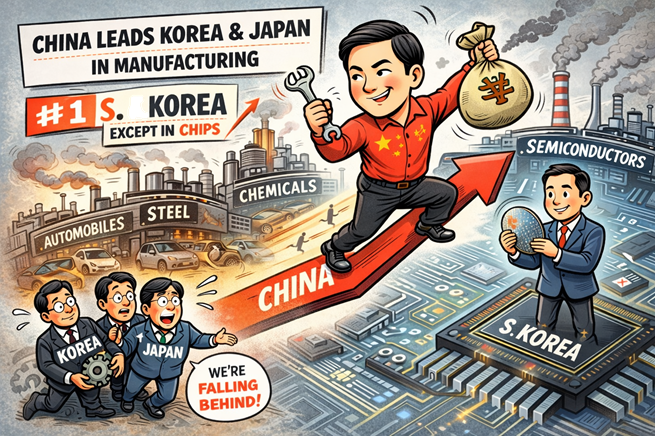
As China Advances, Korea Faces Pressure to Shift Toward High-Value Exports (Image supported by ChatGPT)
SEOUL, Dec. 24 (Korea Bizwire) — China has surpassed South Korea and Japan in four of the five major manufacturing industries that anchor global trade, underscoring a structural shift in East Asia’s industrial balance and intensifying pressure on Seoul to move beyond volume-driven exports, a new report shows.
According to a study released Tuesday by the Korea International Trade Association’s International Trade Institute, China now leads its two regional rivals in automobiles, machinery, steel and nonferrous metals, and chemicals. Semiconductors remain the lone sector in which South Korea has strengthened its competitive edge.
The report compared export competitiveness among South Korea, China and Japan from 2019 through 2024, evaluating both quantitative measures — such as global market share and export volume — and qualitative factors including comparative advantage and value-added content.
China’s advance was broad-based. Building on its long-standing strengths in machinery and chemicals, it also overtook Korea and Japan in automobiles and steel, driven by massive production capacity and a rapid shift toward higher-value products. Analysts said the trend reflects not a temporary surge but a structural transformation of China’s manufacturing base.
South Korea, by contrast, has consolidated its leadership in semiconductors, rising to first place from second over the five-year period. The report attributed the gain to robust global demand for high-end memory chips fueled by the spread of artificial intelligence, as well as sustained real demand for Korean-made semiconductors.
Elsewhere, however, Korea’s position weakened. In automobiles, export volumes and market share increased, but competitiveness slipped to third place as China gained ground through aggressive pricing and rapid expansion in electric and environmentally friendly vehicles. Korea also lost ground to Japan and China in machinery, and to China in steel and nonferrous metals.
“China’s export competitiveness is no longer confined to specific industries but reflects a manufacturing-wide structural shift,” Jin Ok-hee, a researcher at the trade institute, said in the report. She argued that South Korea must pivot away from volume competition and focus more sharply on technology and value creation.
The study recommended widening Korea’s lead in areas of clear advantage, such as semiconductors, while adopting more finely targeted strategies by market and product in sectors where competition is intensifying — a challenge that comes as the Democratic Party–led government seeks to recalibrate industrial and export policy amid slowing global growth and deepening regional rivalry.
Ashley Song (ashley@koreabizwire.com)