

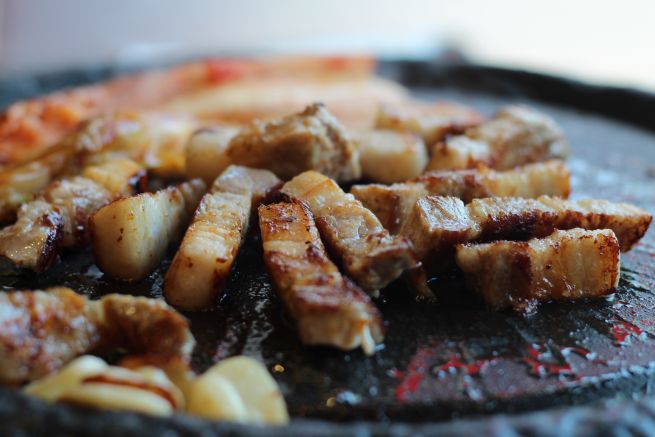
Samgyeopsal (grilled pork belly) is one of Korea’s representative everyday dishes.(Image courtesy of Yonhap)
SEOUL, Aug. 23 (Korea Bizwire) — Colorectal cancer, long considered a “Western disease,” is surging in South Korea, particularly among people in their 20s and 30s, where cases are growing at an annual rate of about 4 percent. A new study has identified Western-style eating habits as a major driver of the trend.
A joint research team led by Kang Dae-hee of Seoul National University’s Department of Preventive Medicine and Shin Sang-ah of Chung-Ang University’s Department of Food and Nutrition analyzed 82 cohort studies from five Asian countries — South Korea, Japan, China, Taiwan, and Singapore.
The findings, published in the international journal Cancer Causes & Control, mark the first large-scale meta-analysis on diet and colorectal cancer risk focused on Asian populations.
Meat, Processed Foods, and Alcohol Raise Risk
The study found a clear association between meat-heavy diets and colorectal cancer. High consumption of red meat raised risk by 18 percent, while processed meats such as sausages and ham increased it by the same margin on their own. White meats like chicken and turkey were not broadly linked to colorectal cancer but were associated with a 40 percent higher risk of rectal cancer specifically.

Alcohol emerged as the strongest risk factor. (Image courtesy of Yonhap)
Alcohol emerged as the strongest risk factor. Consuming more than 30 grams of alcohol per day — equivalent to more than 500 milliliters of beer or three shots of soju — raised colorectal cancer risk by 64 percent.
Protective Role of Calcium and Balanced Diets
By contrast, calcium intake and healthier dietary patterns lowered risk. People who consumed calcium-rich foods such as milk, dairy products, or small fish eaten with bones had a 7 percent lower risk of colorectal cancer. Diets centered on vegetables, fruits, whole grains, and lean proteins were linked to a 15 percent lower risk of colon cancer.
A Warning for Asia’s Changing Diets
While previous research has focused largely on Western populations, the study underscores that Asians are not immune to the same dietary risks as eating habits shift. Researchers warned that the rapid rise of colorectal cancer among young Koreans may continue unless broader lifestyle changes occur.
M. H. Lee (mhlee@koreabizwire.com)





What exactly is ‘Western disease”? I think you mean the US junk and low quality ultra-processed food?
Please differentiate this, as many ‘western diets’ are much healthier than the Korean meat-heavy overly salty, red chilly-laden and alcohol-fuelled Korean one.
Oh, and yeah, quote: “Alcohol emerged as the strongest risk factor….64% higher risk” Is alcohol a ‘western diet’ thing? Get your facts straight.
Hello, thanks for taking interest in this article.
Because diets with a high proportion of meat are commonly referred to as Western-style diets, that expression tends to be used like a cliché. I’m sorry if it made you uncomfortable.