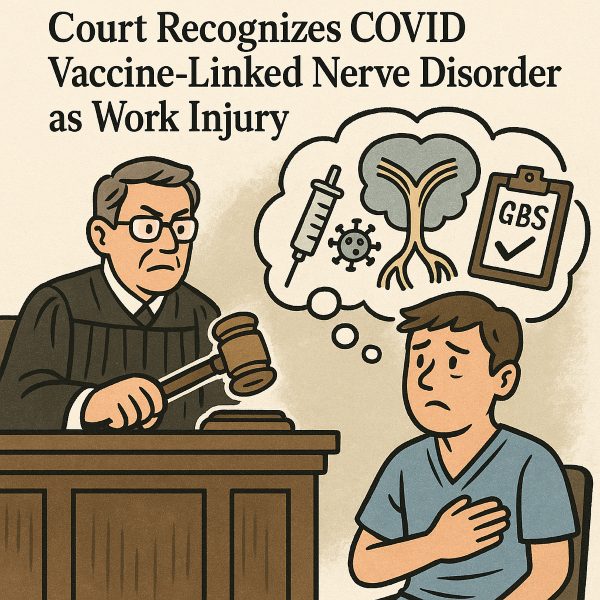
COVID-19 Vaccine Side Effects Ruled Occupational Injury by Seoul Court (Image supported by ChatGPT)
SEOUL, August 5 (Korea Bizwire) — A South Korean appeals court has ruled that a hospital employee who developed severe neurological symptoms after receiving a COVID-19 vaccine is entitled to workers’ compensation, affirming a lower court’s decision.
The Seoul High Court on June 20 sided with a man in his 20s, identified as Mr. A, who filed a lawsuit against the Korea Workers’ Compensation and Welfare Service after his claim for medical benefits was denied. This follows a similar ruling in September last year in favor of the plaintiff.
Mr. A began working as an occupational therapist at a hospital in February 2021 and received the AstraZeneca COVID-19 vaccine the following month, reportedly at the hospital’s recommendation.

He developed fever, vomiting, limb weakness, and altered consciousness later that same night. By May, he was diagnosed with nerve and musculoskeletal damage, and in June, with Guillain-Barré Syndrome—a rare neurological disorder that can cause paralysis.
Despite applying for compensation in early 2022, the agency rejected the claim, arguing that there was no proven causal link between the vaccine and his condition. Mr. A then filed a lawsuit seeking to reverse the decision.
In its ruling, the court acknowledged that while a direct scientific link between the vaccine and Guillain-Barré Syndrome may not be definitively established, the timing and medical history suggested a reasonable connection. The court also noted that Mr. A had no prior underlying conditions and that the symptoms closely followed his vaccination.
“The nature of his work and the need to maintain workplace safety support the inference that vaccination was tied to job performance,” the court said. It concluded that the vaccine likely triggered the condition, warranting recognition as an occupational injury.
The compensation agency appealed the first ruling, but the appellate court dismissed the appeal, stating that the initial judgment was sound and well-founded.
Lina Jang (linajang@koreabizwire.com)