Growth on Pause: How Aging and Low Birthrates Are Reshaping Korea’s Economy (Image courtesy of Yonhap)
SEOUL, May 27 (Korea Bizwire) — As South Korea grapples with a prolonged domestic slowdown, economists and policymakers are sounding the alarm over an increasingly potent structural threat: the country’s shrinking and aging population.
Already facing stagnating consumer sentiment, high inflation, and global uncertainty, South Korea’s economy is now contending with the compounding impact of demographic decline.
Recent government and institutional analyses warn that even as cyclical pressures ease, long-term domestic demand may continue to weaken due to an irreversible population shift.
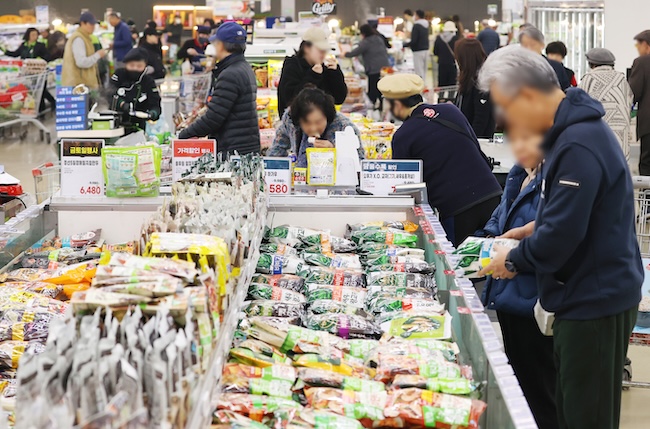
South Korea’s middle class continues to experience a prolonged decline in consumer spending. (Image courtesy of Yonhap)
Stagnant Demand Meets Demographic Drag
Recent data paints a bleak picture. In March 2025, retail sales — a proxy for goods consumption — fell by 0.3% month-on-month, while services output and facility investment dropped by 0.3% and 0.9%, respectively.
According to the Bank of Korea, private consumption shrank 0.1% in the first quarter, and both equipment and construction investment fell sharply.
While much of the slowdown stems from macroeconomic forces — high interest rates, inflation, and external shocks like the December 2024 emergency declaration and renewed U.S. trade tensions — analysts are increasingly focused on the structural weight of demographic change.
The total fertility rate has dropped below 0.8, and the share of the population aged 65 and older exceeded 20% in 2024, pushing South Korea into “super-aged society” status. Since peaking at 51.8 million in 2020, the population has declined by roughly 500,000 over three years, falling to 51.3 million in 2023.
The Ministry of Economy and Finance has begun internal studies to isolate the population-related effects on consumption, aiming to formulate policy responses tailored to both structural and cyclical challenges.
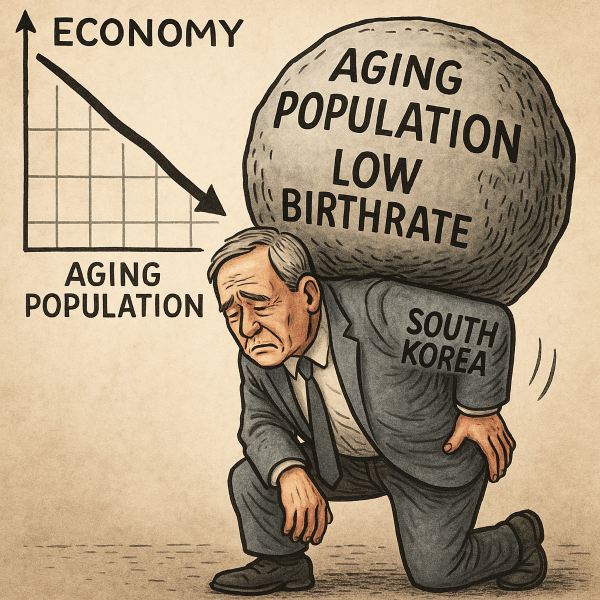
Aging Nation, Slowing Economy: Korea’s Consumption Faces Demographic Cliff (Image supported by ChatGPT)
A Predictable, but Powerful Decline
The outlook is stark. Korea’s population is projected to fall to 51.3 million by 2030 and just 36.2 million by 2072 — a level not seen since the 1970s. The working-age population (15–64) is also in retreat, down from 37.6 million in 2019 to a projected 34.4 million by 2030 and 32.3 million by 2040.
At the same time, the proportion of seniors — who typically spend less — is set to surge from 20.3% in 2025 to 40.1% by 2050.
This shift is expected to erode the country’s growth potential and its domestic consumption base. According to a recent Korea Development Institute (KDI) report, population aging is weakening both labor input and total factor productivity, driving down South Korea’s potential growth rate.
KDI projects growth potential to fall to 1.5% in 2025–2030, 0.7% in 2031–2040, and just 0.1% in the 2040s. Under pessimistic scenarios, the country could even enter negative growth.
The Bank of Korea has also warned that average household consumption is expected to decline by 0.7% annually through 2035 due to aging and longevity. With people living longer, many are saving more now to prepare for retirement, further depressing consumption in the short term.
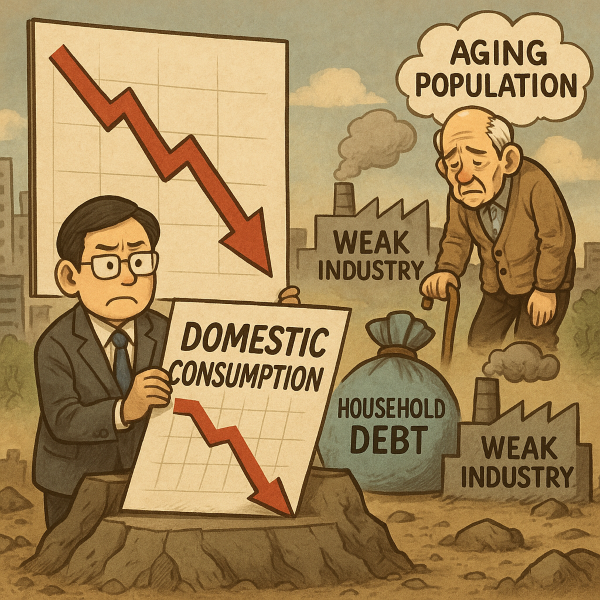
South Korea’s domestic consumption has entered a sustained decline, not due to temporary shocks like COVID-19 or inflation, but as a result of entrenched structural challenges, including a rapidly aging population, evolving labor market dynamics, and shifts in the country’s industrial landscape. (Image created by ChatGPT)
Policy Levers May Be Losing Power
While fiscal measures such as a second supplementary budget are under consideration to boost demand, some economists caution their effectiveness may be muted in the face of structural change.
“Declining growth and consumption due to demographic contraction is a clear long-term trend,” said Jung Kyu-chul, head of economic forecasting at KDI. “It will become increasingly difficult to stimulate growth through domestic demand alone.”
Economists argue that to mitigate the decline, structural labor reforms — including raising the retirement age and rethinking wage structures — will be critical. “We need to enable older adults to remain economically active,” said Yang Joon-suk, economics professor at the Catholic University of Korea. “Only then can we hope to counterbalance the effects of falling birthrates and shrinking consumption.”
With traditional tools of economic stimulation losing potency, South Korea faces a new policy frontier — one where demography, not just interest rates, will define the nation’s economic trajectory.
M. H. Lee (mhlee@koreabizwire.com)