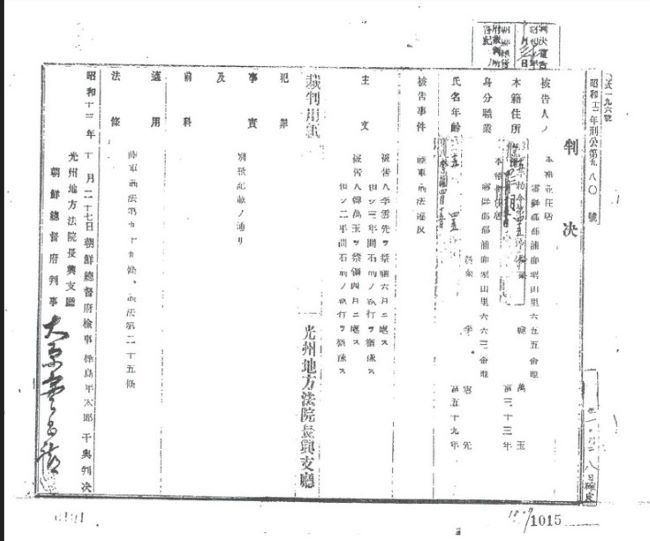
Legal document made public by Yeongam County (Image courtesy of Yeongam County)
YEONGAM, Aug.12 (Korea Bizwire) – The South Korean municipality of Yeongam has confirmed two court rulings from the Japanese colonial era, which reveal that local residents who exposed the forced recruitment of comfort women by the Japanese military were criminally punished.
The incidents, which occurred in 1938, shortly after the start of the Second Sino-Japanese War, involved villagers being penalized for spreading rumors about the recruitment of women for military sexual slavery.
The documents, uncovered from the National Archives of Korea, include original court rulings and translated copies that detail the convictions. According to the records, the Gwangju District Court’s Jangheung branch sentenced four Yeongam residents on charges of violating military law by spreading “false rumors” about the recruitment of women to serve the Japanese army.
One such case involved a mother, who protested when the village headman surveyed local women, including her 15-year-old daughter, to identify potential recruits.
According to the court ruling dated October 7, 1938, a resident named Song Myung-sim was sentenced to four months in prison, suspended for two years, after she confronted the village headman. She had learned from a local man that women aged 12 to 40 were being gathered for the army’s comfort units in Manchuria.

The black and white video footage, a mere 18 seconds long, shows seven comfort women presumably in front of a comfort station. It is believed to have been filmed by a photographer from the U.S. military, which occupied Songshan, China in September, 1944. (Image courtesy of Seoul National University’s Human Rights Center)
A second case on October 27, 1938, resulted in the conviction of Lee Un-seon, who was sentenced to six months in prison, suspended for three years, and Han Man-ok, who received a four-month sentence with a two-year suspension. They were found guilty of spreading similar rumors about the forced recruitment of young women.
The release of these court documents is the first confirmation that the Japanese colonial regime took legal action against individuals for exposing the practice of recruiting women for military sexual slavery. Yeongam’s Mayor, Woo Seung-hee, expressed intentions to honor the descendants of those unfairly punished, exploring options for posthumous recognition such as medals.
These revelations shed new light on the measures Japan took to suppress knowledge of its wartime atrocities, including the systematic abuse of women as comfort women, and the efforts to silence those who dared to speak out.
M. H. Lee (mhlee@koreabizwire.com)