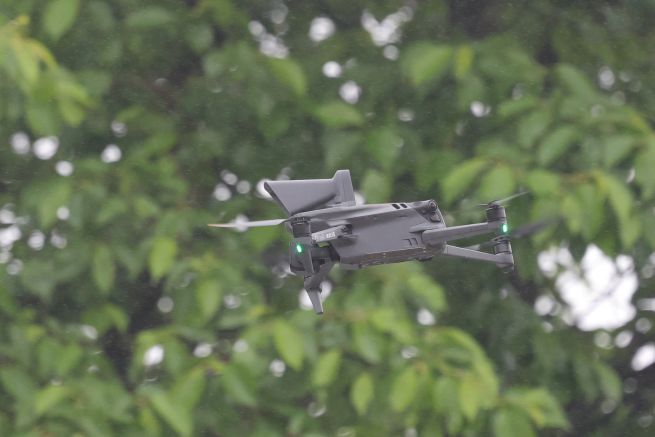
A speaker-equipped drone broadcasting an evacuation message (Image courtesy of Yonhap)
SEOUL, Nov. 14 (Korea Bizwire) — South Korea’s drone exports have grown nearly tenfold over the past two years, yet the country remains a marginal player in the global market — a gap that analysts say requires urgent policy and industry action to close.
According to a report released Friday by the Korea International Trade Association (KITA), global drone trade more than doubled from US$2.47 billion in 2022 to US$6.11 billion last year.
Several countries made striking gains: Poland’s drone exports jumped from US$33 million to US$550 million, boosting its global share from 1.2 percent to 9.6 percent. The United States and Israel also expanded their market presence.
South Korea’s exports rose sharply from US$2.81 million to US$27.54 million during the same period — but its global share reached only 0.48 percent, placing it 20th worldwide, behind Denmark and Thailand.
The report found that Korea’s drone industry continues to face structural weaknesses, including limited technical manpower, insufficient research and development infrastructure, and heavy reliance on Chinese components.
More than 80 percent of Korea’s drone and component exports are concentrated in just five countries, underscoring the severity of market concentration.
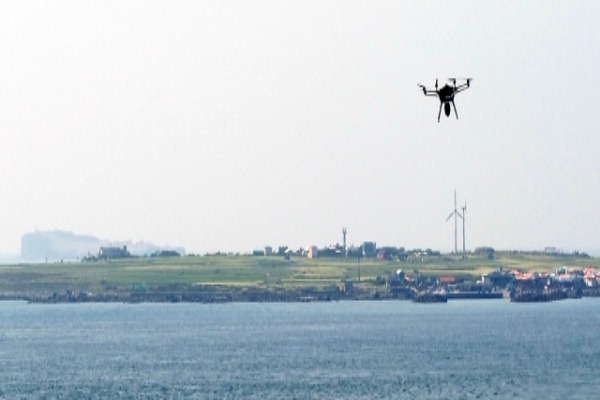
Drones are being used for a variety of purposes on Jeju Island, including deliveries to areas that are difficult to reach. On 11 August 2024, drone delivery from the main island of Jeju Island to the Marado-Gapado area began in earnest. (Image courtesy of Yonhap)
To build competitiveness, KITA recommends shifting toward higher value-added products — such as heavy-lift delivery drones and AI-powered autonomous systems — diversifying into emerging markets, expanding AI- and cloud-based component production, and developing Drone-as-a-Service (DaaS) applications in areas like imaging, analytics and wildfire monitoring.
Global demand for drones is expected to expand further as autonomous flight technology advances and major countries relax regulatory barriers, said KITA senior researcher Kim Moo-hyun. Strengthening parts self-sufficiency and building a service-oriented export ecosystem, he added, will be essential for Korea to secure a meaningful foothold in the industry.
Kevin Lee (kevinlee@koreabizwire.com)